
Texas Continued Data Center Permitting after the Governor’s Pause

On September 21, 2026, Governor Abbott wrote a letter directing the Texas Commission on Environmental Quality (TCEQ) “to halt all permits sought by data centers.” He framed this pause as an attempt to give ERCOT, the Public Utility Commission of Texas and the Texas Water Development Board time to review the impact of data centers on the Texas grid and existing water resources. He also wrote that “no other state agency shall move forward with regulatory approvals related to data centers until this information is acquired.”
However, working closely with Public Citizen, FracTracker reviewed TCEQ’s records and found that the agency continued moving data center projects forward: mailing public notices for major-source air permit applications, advancing applications through review, issuing air emission-limit certifications, and approving construction stormwater coverage. Since September 21, TCEQ has continued reviewing applications and issuing approvals that allow data center development to proceed.
Governor’s order
Amidst an unprecedented national build-out of data centers and related fossil fuel infrastructure, Texas is the country’s largest market for new data center development. The scale and speed of the build-out have few historical precedents, placing immense pressure on regulators, the Texas grid and water resources, and the communities where these projects are proposed. As the Governor stated in his September 21 letter, the pause was intended to ensure “Texans’ natural resources and way of life are protected.” Abbott’s concern about the negative impacts of data center development marks a shift from his earlier wholehearted embrace of development. On November 14, 2025, he celebrated Google’s data center investments in Texas, stating: “Texas is the epicenter of AI development, where companies can pair innovation with expanding energy.”
Over the past several months, Abbott has publicly changed his position. On August 3, 2026, he directed the Public Utility Commission and ERCOT to audit all data centers advancing through ERCOT’s interconnection process, including their projected electricity and water use, on-site generation, tax incentives, ownership and community impacts. On September 14, he directed the Texas Water Development Board to enforce water-use reporting requirements and partner with ERCOT on the audit. On September 21, he issued his directive to TCEQ and said he would work with the Legislature to eliminate financial incentives for data centers.
The Governor’s letter to TCEQ ordered the pause in three ways:
- TCEQ was directed “to halt all permits sought by data centers.”
- TCEQ was directed “to pause the issuance of all permits related to data center projects until ERCOT completes its review.”
- More broadly, “no other state agency shall move forward with regulatory approvals related to data centers until this information is acquired.”
On October 14, responding to FracTracker’s request for clarification, TCEQ stated that the agency “has paused the issuance of all air and water permits and authorizations related to the construction or development of infrastructure directly supporting data centers while ERCOT completes its comprehensive grid and community impact audit.”
When FracTracker asked whether applications could still move through review without a final approval, TCEQ responded: “Companies can submit applications, but their applications will not advance through the review process.”
That response made TCEQ’s stated position clear: a pause on both the review and issuance of data center permits and authorizations. A review of the agency’s own records found something else.
What the records show
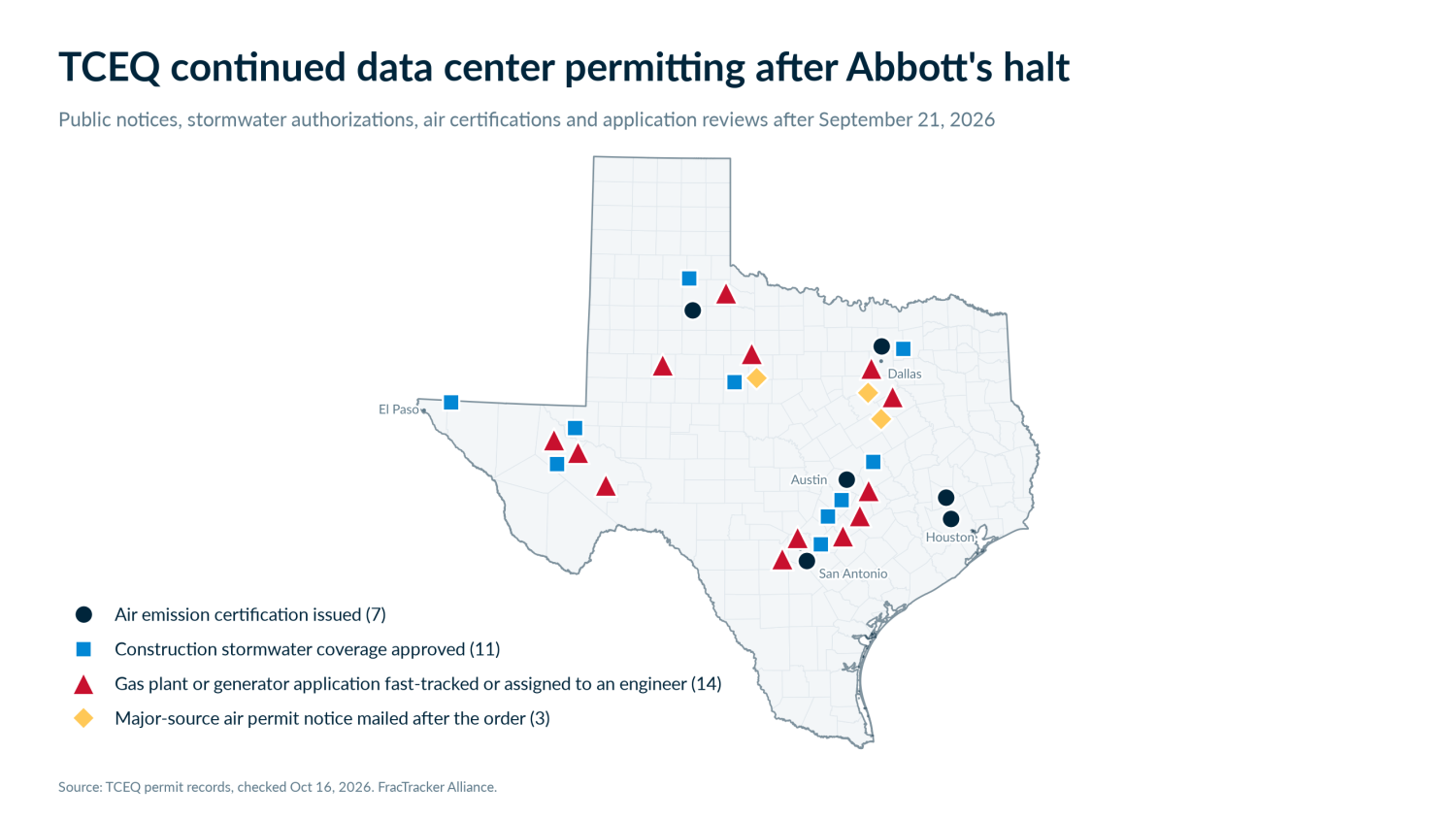
Our review of permitting activity found four kinds of TCEQ actions after September 21: public-notice mailings, stormwater authorizations, air emission-limit certifications and applications continuing to advance through review. Taken together, these actions do not signal an agency trying to pause.
Public Citizen found three preliminary-decision notices for major-source air permit applications that TCEQ mailed on September 22, the day after the Governor’s order. The notices concern VoltaGrid’s ABI-1 plant serving Vantage’s data center campus in Shackelford County, Nexus’s self-powered data center in Hubbard, and NRG Prairie Energy Center in Hill County. The public-notice process continued: VoltaGrid’s notice was published September 23 and Nexus’s September 24. Publication starts the 30-day public-comment period. Given the Governor’s order, people could reasonably have assumed that permitting had stopped while deadlines were actually continuing. That could mean people miss their opportunity to comment or request a public meeting or contested case hearing.
FracTracker also found eleven construction stormwater records with approvals after September 21. These include large hyperscale data centers like Caldwell Valley Technology Park in Caldwell County, Crusoe’s Abilene campus and EdgeConneX’s Cedar Creek campus. All three received new coverage. New coverage removes a required regulatory barrier for clearing, grading and excavation. In other words, these authorizations allow data center construction to proceed. They may not be the only approvals a project needs, but without the required stormwater coverage, that work cannot legally begin.
TCEQ told FracTracker that companies could submit applications, but their applications would not advance through review. We found that this was not the case. In our review, FracTracker found 14 applications for gas plants and generators serving data centers or supporting their construction that continued through review after September 21. An example is Edged Dallas’s generator registration. This permit was filed and expedited on October 6, with an engineer assigned one day later and initial review completed by October 9. Instead of a pause on review, TCEQ has moved forward in their review process, in many cases expediting review. While this is not the same as issuing permits, it certainly appears to violate the Governor’s order that “no other state agency shall move forward with regulatory approvals related to data centers” until the PUC, ERCOT and the Texas Water Development Board complete their reviews.
As further evidence of the regulatory process continuing as normal amidst the pause, FracTracker also identified seven emission-limit certifications that TCEQ’s database recorded as “issued” after the order. These company-submitted certifications establish enforceable emissions limits under separate air authorizations. One, for Decennial’s SA01 Data Center in San Antonio, was recorded October 16, two days after TCEQ told FracTracker it had paused authorizations.
What counts as infrastructure supporting a data center?
TCEQ said its pause included infrastructure “directly supporting data centers.” Reading the permits, how the agency interprets that phrase is open to question.
On October 8, TCEQ approved construction stormwater coverage for LCRA’s Misty substation in Caldwell County. LCRA describes the $111.6 million project as serving Bluebonnet Electric Cooperative’s load. Tract, the developer of Caldwell Valley Technology Park, has a facility-design agreement with Bluebonnet for an initial 360 MW in 2028, and a proposed 1,500 MW gas plant associated with Tract lists Misty as its connection point. That points to infrastructure being built to support data centers. Nothing in the stormwater record calls it a data-center project.
LCRA’s financial statements explain that transmission costs are shared across electricity consumers in ERCOT. Infrastructure built to serve data centers can therefore affect other people’s electricity bills. We have not yet established how Misty’s full cost will be divided. FracTracker is reviewing these transmission upgrades as well. For this report, the question is how TCEQ decides which of them fall under the pause.
We see a similar question with Maverick Lodge, a 4,000-bed workforce camp for data-center construction. Haskell County Ventures filed a gas-generation application to power the camp, which TCEQ expedited October 14 and assigned to an engineer October 16. A pause on infrastructure supporting data centers needs to account for the larger set of projects being filed as part of that build-out.
Lack of transparency around data center development
Identifying which permits corresponded to data centers was particularly challenging. Applicants might be separate power companies, contractors or LLCs whose names reveal little about the campuses they serve. At FracTracker, we compared the permits with our database of data-center locations. SMS Horizon EC1, for example, filed for a plant at the same road corner as Poolside’s proposed campus in Pecos County. The LLC also shared a name with an LLC associated with the Poolside data center. The location suggests a connection, but we have not found a document tying the two together.
What we need is a clear public database connecting each campus to its owners, related LLCs, power plants, water infrastructure, permit numbers and review status. Texas could follow the example of Pennsylvania, which has a centralized Data Center Permit Tracker. Residents should be able to see which projects are being proposed and what infrastructure is being built to serve them.
Recommendations
Data-center developments moving through permitting despite the Governor’s order show why Texas needs a statewide moratorium. A moratorium would give Texans more time to study the impacts of this build-out. ERCOT, the PUC and the Texas Water Development Board need time for cumulative-impact studies, regional analyses of proposed data-center clusters and long-term planning. Local communities need more opportunities to participate in decisions about land use and data-center development.
TCEQ needs to comply with its stated pause on reviewing applications and issuing authorizations for data centers and the infrastructure supporting them. That includes expedited review, air certifications and stormwater coverage. It should also extend or reopen the affected comment periods so people have a full opportunity to comment after the pause ends. People who reasonably thought permitting had stopped should not lose their chance to participate.
TCEQ should explain any failures to pause review and permitting. TCEQ’s compliance update to the Governor is due today, October 19. This compliance update should be made available to the public. If it does not address the discrepancies we found, TCEQ should produce an addendum giving a public accounting of how it advanced permitting after September 21 and what it will do to prevent that from continuing.
Records and sources
We checked records through October 16, 2026. Dates and sources are linked in the accompanying spreadsheet.
Additional sources include the Governor’s September 21 letter, TCEQ’s construction general permit and public guidance, TCEQ’s emails to FracTracker, and TCEQ’s permit and public-notice records. This report benefited greatly from the collaboration with Public Citizen, who identified additional air, water and major-source permits that our own search did not find, which we then reviewed and included here.
FracTracker Alliance helps communicate the risks of oil and gas and petrochemical development to advance just energy alternatives that protect public health, natural resources, and the climate.
By contributing to FracTracker, you are helping to make tangible changes, such as decreasing the number of oil and gas wells in the US, protecting the public from toxic and radioactive chemicals, and stopping petrochemical expansion into vulnerable communities.
Your donations help fund the sourcing and analysis of new data so that we can keep you informed and continually update our resources.
Please donate to FracTracker today as a way to advocate for clean water, clean air, and healthy communities.
Donate now
Leave a Reply
Want to join the discussion?Feel free to contribute!