
Insights on Southwestern Pennsylvania Data Center Proposals
Insights on Southwestern Pennsylvania Data Center Proposals
What FracTracker’s 2026 Data Stewardship Sprint found across 12 proposals in six counties

Introduction
Since mid-2025, FracTracker researchers have identified 12 data center proposals across six Southwestern Pennsylvania counties. If projects with disclosed power plans reached their highest stated capacities, they would add about 12.5 GW of gas-fired generation. Running around the clock, that would consume the same amount as roughly three-quarters of the electricity Pennsylvanians used in 2024. Many proposals target communities already shaped by fossil-fuel infrastructure and legacy industrial pollution. Residents in these communities frequently face limited access to clear, trustworthy project information while dealing with compressed approval timelines and technical, hard-to-navigate decision-making processes. These proposals put residents’ air quality, water resources, public health, and community future at stake.
During a nine-week Data Stewardship Sprint in summer 2026, FracTracker trained four Pittsburgh-based student interns to investigate proposed data center developments and produce information that communities could use in local decisions. The Data Stewardship Sprints researched 12 data center proposals across Allegheny, Washington, Westmoreland, Beaver, Greene, and Indiana counties. Each intern was assigned 3-4 data center targets. The team attended public meetings, filed Right-to-Know requests, reviewed permits, researched ordinances and zoning designations, mapped potentially affected community resources and ecological sites, and spoke with residents to get their side of the story.
Contents
What is a data center, and why should communities care?
A data center is a facility filled with computer servers and related equipment that stores, processes, and transmits digital information. Traditional data centers support services such as websites, streaming, cloud storage, and financial services. The current wave of data centers are specifically designed for artificial intelligence. Unlike traditional data centers, which were smaller and had comparatively modest electricity demands, AI data centers are major industrial developments. Generative AI requires a different computing architecture, where large clusters of specialized graphics processing units (GPUs) train models that then respond to user requests. These chips draw substantially more electricity and produce more heat than conventional servers. A decade ago, data centers consumed less than 2% of the electricity used by the United States. By 2028, the Lawrence Berkeley National Laboratory expects data centers' electricity consumption to grow to between 6.7% and 12% of U.S. electricity use by 2028, equivalent to the electricity use of up to 55 million American homes.
AI-oriented hyperscale campuses concentrate computing equipment at an unprecedented scale. The International Energy Agency reports that the power density of AI servers increased elevenfold between 2020 and 2025, and the IEA expects a further fourfold increase by 2027. A single advanced server rack, roughly the size of a large refrigerator, may soon require as much power at peak operation as dozens of homes. Training, reasoning, image and video generation, and continuous modeling use can create large, rapidly changing electrical loads. Consequently, these campuses may require hundreds or thousands of megawatts (MW) of reliable, round-the-clock power, substantial amounts of water for cooling, and new transmission lines, substations, backup generators, power plants, pipelines, and other supporting infrastructure. This means their effects can extend far beyond the property boundaries where they are built.
For communities, the important questions include: How will the data center be powered? How much water will it use? Who will pay for necessary infrastructure and power upgrades? What protections will govern noise, toxic emissions, light pollution, stormwater discharge, emergency response, and future expansion?
The environmental impacts of AI data centers include industrializing rural land, air pollution, high water use, noise, and light pollution. Because many data center proposals depend on fossil fuel infrastructure, they prevent communities from transitioning to cleaner energy sources. Large data center campuses can occupy hundreds or thousands of acres, replacing farmland, forests, and natural areas. Data centers also produce constant light pollution and noise pollution comparable to a jackhammer or jet engine running at all hours of the day. The long-term impacts of both light and noise pollution include hearing loss, stress, insomnia, cardiovascular problems, and decreased quality of life.
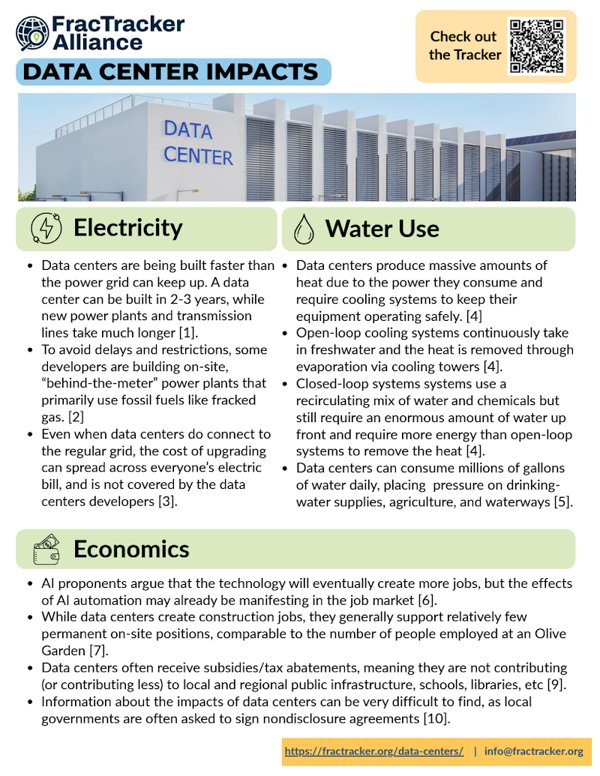
In many instances, data centers are being built faster than the power grid can keep up. A data center can be built in 2-3 years, while new power plants and transmission lines can take much longer. To skip a lengthy regulatory process, developers have started building their own on-site “behind-the-meter” power plants, many of which rely on fracked gas. This can raise air-quality and community-health concerns for nearby residents. Burning fracked gas directly or indirectly for data center energy produces carbon dioxide, which exacerbates climate change, while gas extraction, transportation, and use releases methane and contributes to local air and water pollution that harms frontline communities. Increased fracking to meet this new demand for gas means more water use, more pollution, more toxic waste, and more health impacts for frontline communities. And even when data centers do connect to the regular grid, the cost of upgrading the grid can spread across everyone’s electric bill. Large new electricity loads can also affect grid reliability, leading to blackouts.
While data center developers promise local jobs, economists studying AI automation warn of potential job losses across the broader economy. The effects of AI automation may have already shown up in the job market for young workers entering the workforce for the first time, with recent college graduates facing a 6% unemployment rate compared to 4% across the whole workforce. At the same time, data center operators and developers present data centers as job creators that contribute to local economies. To date, little evidence shows that data centers have a positive impact on net jobs created. While data centers create construction jobs, they generally support relatively few permanent on-site positions, comparable to the number of employees employed at an Olive Garden. This problem is exacerbated as many data centers receive subsidies/tax abatements, meaning they are not contributing (or contributing less) to local and regional public infrastructure, schools, libraries, and other community resources. Additionally, information about economic, energy, and environmental impacts can be difficult to find, as local governments are often asked to sign NDAs by data center operators looking to develop in their area.
Finally, AI data centers produce massive amounts of heat because of the power they consume, and therefore require cooling systems. Liquid-based cooling systems can fall into two categories: open-loop (evaporative) systems and closed-loop systems. Open-loop systems continuously take in freshwater to absorb heat, then release it into the atmosphere through evaporation via cooling towers. Closed-loop systems use a mix of water and cooling chemicals to remove heat through technologies such as heat exchangers. Both systems can require millions of gallons of potable (drinkable) water, which puts pressure on local drinking water supplies, agriculture, and waterways. Closed-loop systems are often advertised as the more environmentally friendly option since they reuse the same liquid for cooling, though they require more energy to operate than evaporation-based methods. When accounting for water used to produce that extra energy, closed loop cooling systems may require even more water than the evaporative cooling systems. The up-front water input for closed-loop systems is still substantial, and the water cannot be recirculated in perpetuity. Closed-loop systems also use glycol, corrosion inhibitors, PFAS, and other treatment chemicals, and improper storage, leaks, or disposal can then create soil and water contamination risks. Water-use estimates should distinguish total system capacity, daily consumption, and the amount ultimately discharged or evaporated.
Why is Southwestern Pennsylvania attractive to data center developers?
Southwestern Pennsylvania offers several attractive features that appeal to data center developers. The region has relatively inexpensive land, access to major fiber-optic routes, abundant water resources, and proximity to population and business centers in the eastern United States. It also contains former coal plants, mines, steelmaking properties, and other large industrial brownfield sites that are zoned for industrial use and may already have transmission connections, substations, pipelines, and water access.
The underlying Marcellus and Utica shale formations are another major factor. Fracked gas supplied more than 40% of the electricity used by U.S. data centers in 2024. Pennsylvania is the nation's second-largest fracked gas-producing state, and proposed local data centers plan to tap the region’s fracked gas for power generation, directly through behind-the-meter generation, or indirectly through increased power grid needs. The consequences of a data center buildout reliant on fracked gas will extend throughout the supply chain, requiring additional fracked wells, pipelines, compressor stations, power plants, and other heavy industry related to extraction. This new infrastructure will bring pollution and negative health effects to communities living near data centers, midstream infrastructure, and the extraction itself. Because air pollution, watersheds, energy infrastructure, and electricity markets do not stop at municipal boundaries, regulators must evaluate the cumulative effects of these projects across the entire region.
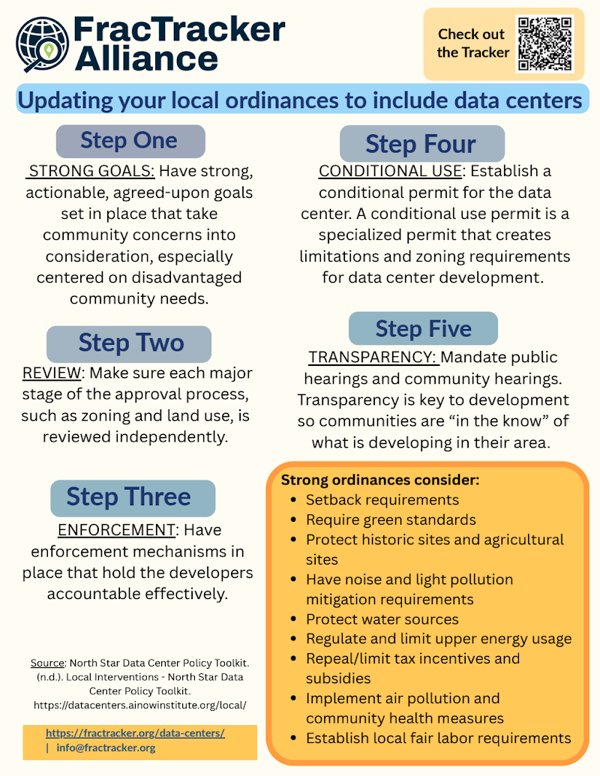
The novelty and complexity of hyperscale data centers challenge local regulation and oversight. Many Pennsylvania municipalities do not define data centers in their zoning codes, leaving officials to evaluate large energy and industrial projects under rules written for warehouses or industrial facilities. Developers may seek variances or approvals before municipalities can adopt project-specific standards. Limited disclosure compounds this problem. Nondisclosure agreements and fragmented permitting records can prevent residents and local officials from evaluating energy demand, water use, pollution, public costs, and proposed tax incentives before decisions occur.
Southwestern PA Data Centers
Through Data Stewardship Sprints, FracTracker worked with community organizations in four southwestern Pennsylvania communities to research active proposals and provide maps, permit records, and other information for local decision-making. Some proposals are moving quickly through the approval process, while others remain proposals or land advertisements with limited public information. We researched all known data center proposals and projects in Allegheny, Beaver, Westmoreland, Indiana, Washington, and Greene Counties and chose to focus on Homer City Energy Campus, Springdale Dynamo Data Center, Upper Burrell Data Center, and Project Phoenix for further in-depth research.

Indiana County
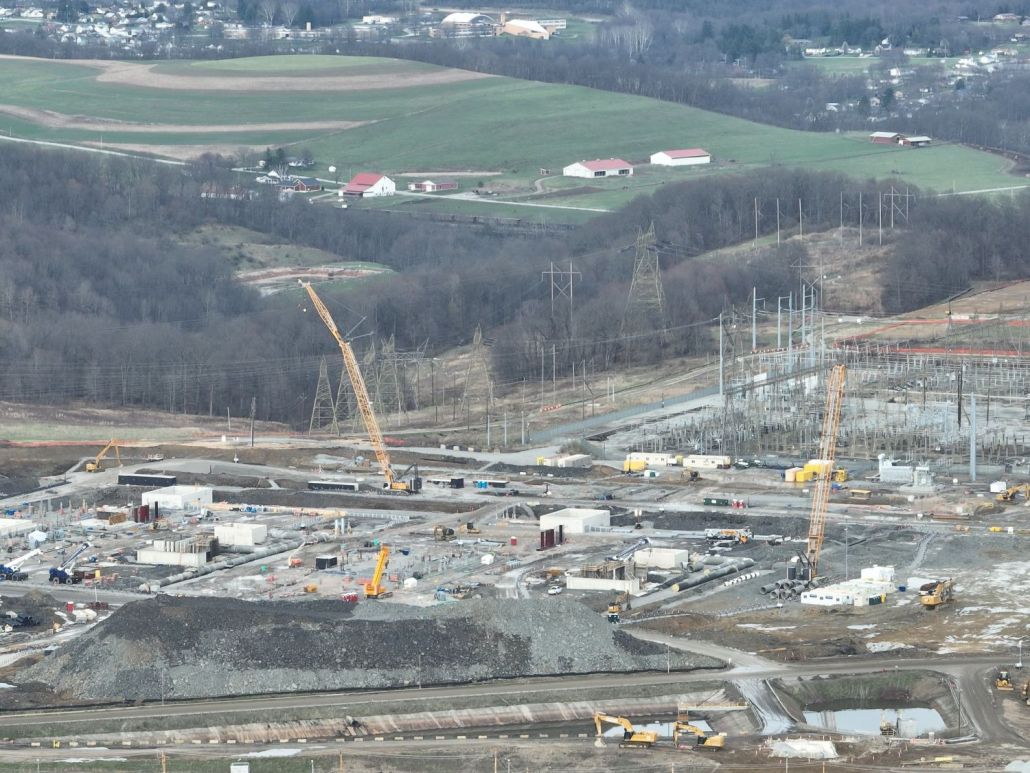
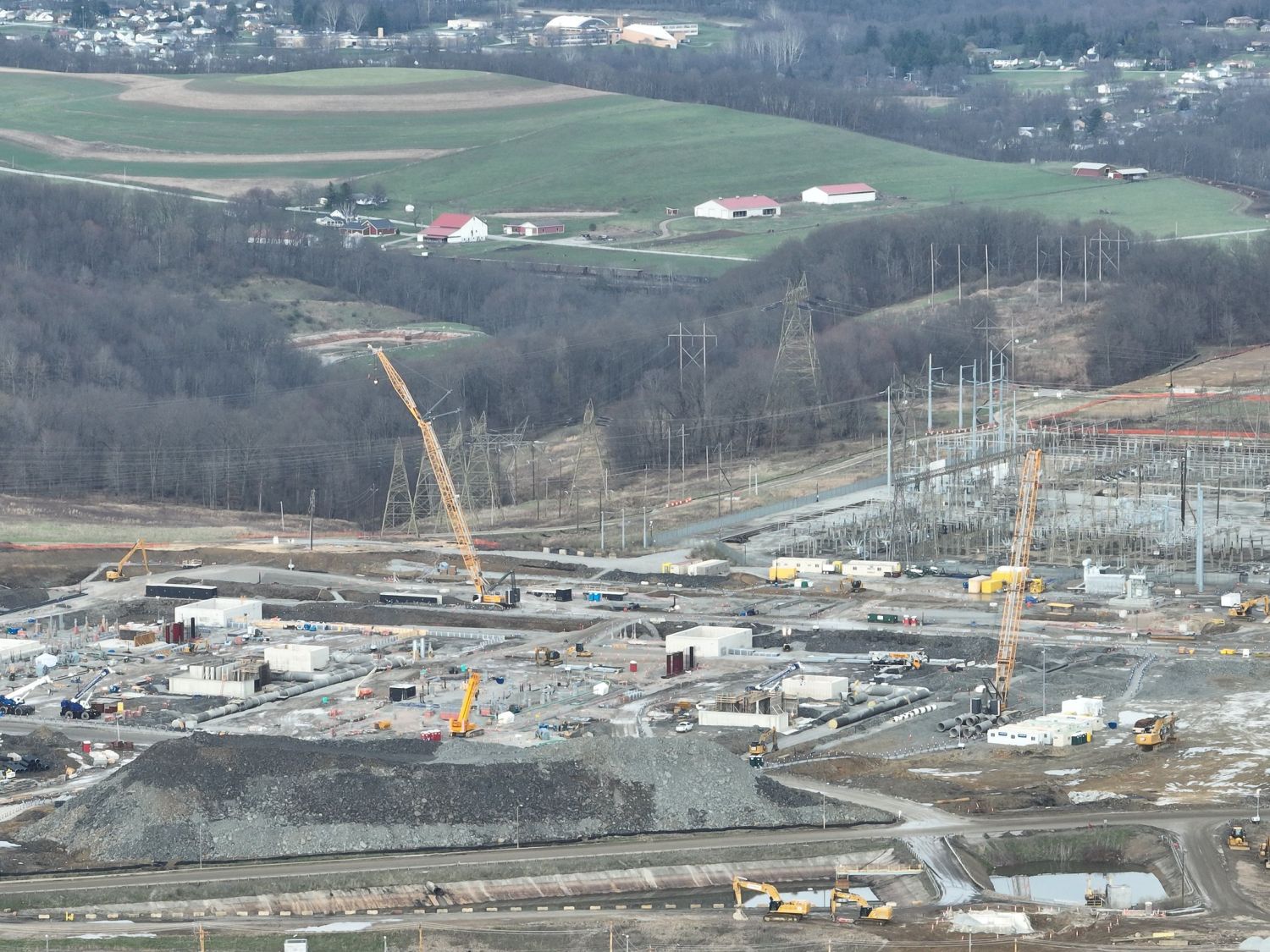
Indiana County, a rural county with roughly 83,000 residents in Southwestern Pennsylvania, is now at the center of massive energy buildout. The former Homer City Generating Station is being redeveloped into Homer City Energy Campus. This $10+ billion 4.5 GW fracked gas-fired power plant will be one of the largest of its kind, on a campus of about 3,200 acres (approximately five square miles). This is enough to power an estimated 3.75 million homes1. The power plant may supply a sprawling Amazon data center.
In addition, the county may soon serve as an electric transmission junction, with the proposed Buttermilk Falls substation adding two new 765 kilovolt (kV) transmission lines (the highest voltage tier used in North America) that connect the region to the broader PJM grid as part of the Kammer-Juniata Transmission Project. The $1.7 billion project (Proposal 237) would run 220 miles from West Virginia into Pennsylvania. Though the project is not built to serve Homer City specifically, PJM has justified it based on statewide data center growth broadly. PA's Office of Consumer Advocate (OCA) criticized PJM for failing to account for Homer City's own 4.5 gigawatts of already-announced capacity when calculating the necessity of the transmission line. The proposal itself has drawn formal objections from state regulators over an inadequate public comment window, from the OCA over an estimated $9 billion in ratepayer-funded costs, and from The Nature Conservancy over its route cutting through corridors of Appalachian wildlife migration.
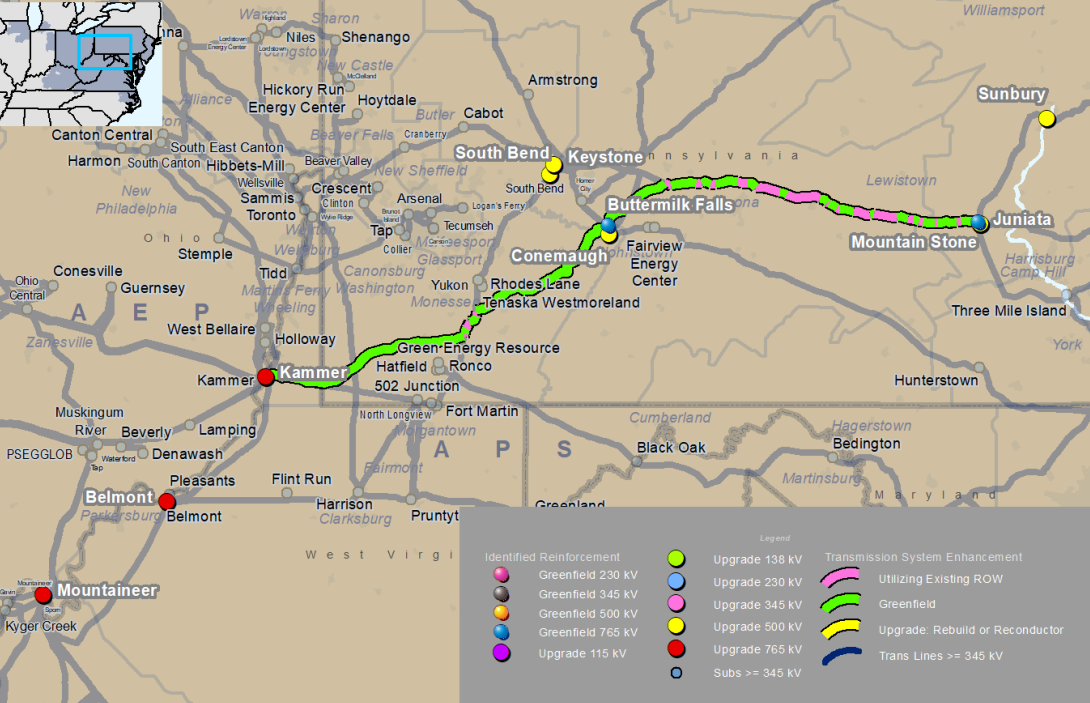
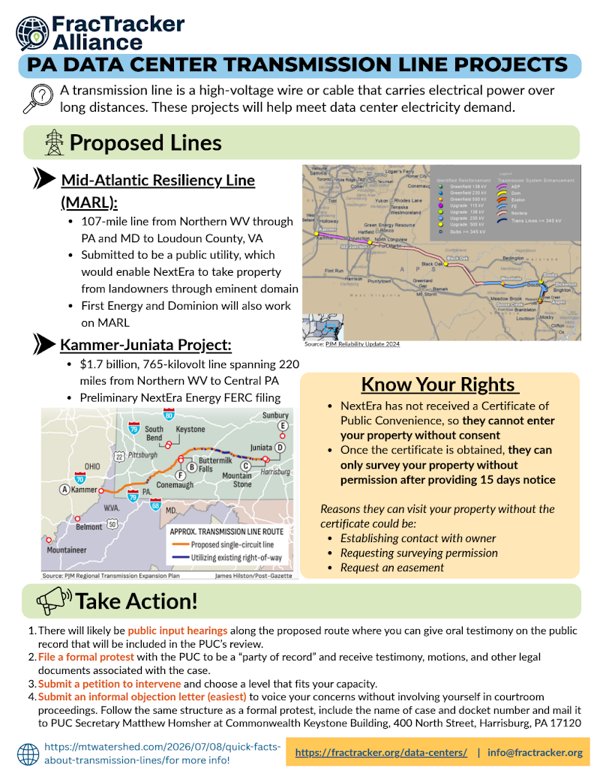
Table 1. Data Centers in Indiana County, PA
| Name and address | Status | Stakeholders | Power |
|---|---|---|---|
| Homer City Energy Campus 1750 Power Plant Rd, Homer City, PA 15748 | Under construction | Homer City Redevelopment (developer) Kiewit (contractor) AWS (possible tenant) | 4.5 GW, behind-the-meter gas and grid connection |
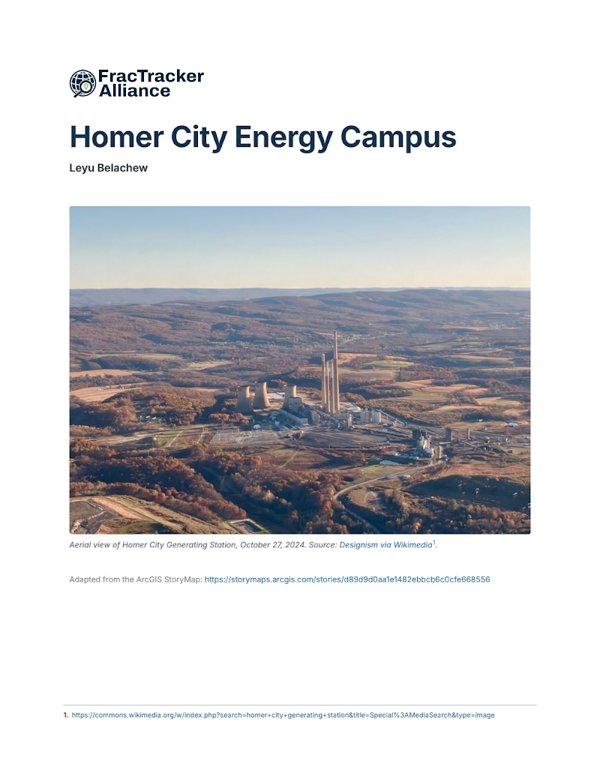
Homer City Energy CampusUnder construction · 4.5 GW, behind-the-meter gas and gridResearch by Leyu BelachewSite packet (PDF) · Story map in a new tab
Explore the Homer City Energy Campus story map
Allegheny and Westmoreland Counties
With a population of 1.22 million, Allegheny County is Pennsylvania's second-largest county. In addition to Pittsburgh, Allegheny County includes 96 boroughs, 29 townships, and 3 home-rule municipalities. The region has been shaped by the rise and fall of local industry. Allegheny County’s population has declined sharply in the last couple of decades of the 20th century. Unsurprisingly, smaller industrial towns faced the heaviest losses because they could not adapt to the 21st-century economic landscape the way a larger city like Pittsburgh could.
Westmoreland County is significantly smaller, at slightly under 350,000 residents. Unlike Allegheny County, its population has declined much more slowly over the last century. Regardless, the county’s population has dropped by almost 9,700 over the last seven years.
The proposed Dynamo DC data center in Springdale Borough and TECfusions’ proposed Keystone Connect Data Center in Upper Burrell are only about five miles apart, despite being in different counties. Developers identified both former industrial properties as attractive sites because they already have industrial zoning and access to energy infrastructure. The former Cheswick Generating Plant in Springdale also offers a legacy grid connection.
Table 2. Data Centers in Allegheny and Westmoreland Counties, PA
| Name and address | Status | Stakeholders | Power |
|---|---|---|---|
| Springdale Dynamo Data Center 151 Porter St, Springdale, PA 15144 | Permits under review | Allegheny DC Property Co (developer) | up to 330 MW, grid connection |
| Upper Burrell Keystone Connect Data Center 100 Technical Dr, New Kensington (Upper Burrell), PA 15068 | Permit review complete, partially operational | TECfusions (developer), TensorWave (tenant) | up to 3 GW, behind-the-meter gas and grid connection |

Springdale Dynamo Data CenterPermits under review · up to 330 MW, grid connectionResearch by Weronika PrzedworskaSite packet (PDF) · Story map in a new tab
Explore the Springdale Dynamo Data Center story map
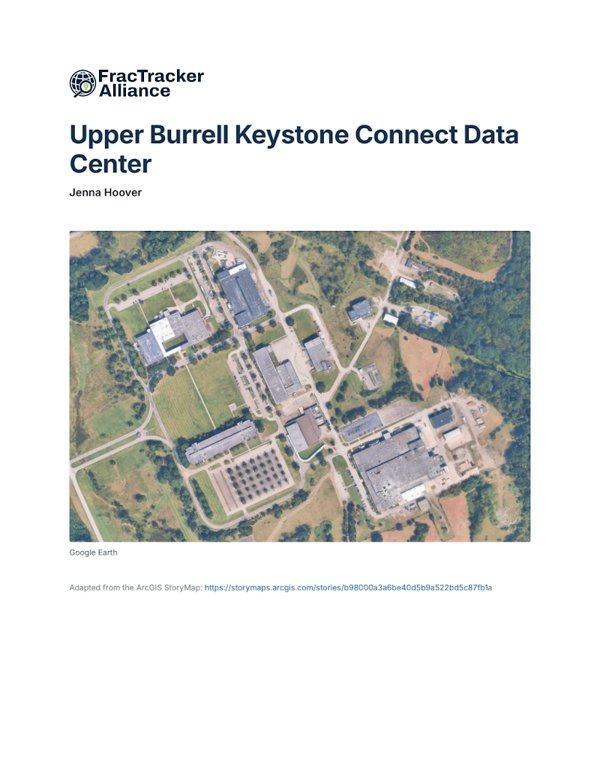
Upper Burrell Keystone Connect Data CenterPartially operational · up to 3 GW, gas and gridResearch by Jenna HooverSite packet (PDF) · Story map in a new tab
Explore the Upper Burrell Keystone Connect Data Center story map
Beaver County
Beaver County was once dominated by the steel industry that took advantage of the Ohio River running through the center of the County. The decline of the steel industry left the County with many brownfield sites, polluted air and water, and a struggling economy. The county is made up of many municipalities and cities with small populations. The two largest cities are Aliquippa, with 9,079 residents, and Beaver Falls, with 9,005 residents. Midland Borough is home to 2,293 people, 1,852 live in Big Beaver Borough, and a mere 159 people in Shippingport. Twenty-three percent of Beaver County’s population is 65 or older (3.4% higher than the PA average) and 19% are under 18 (0.7% lower than the PA average), with these populations being especially vulnerable to effects from pollution. The county's employment rate is 59.7% (0.6% lower than the PA average).
To stimulate the economy and bring jobs to the area, the County has tried to attract developers from many industries to its various brownfield sites. One of these developers was Shell, which opened their ethane cracker plant in 2022 and has been engaged in ongoing legal battles for exceeding its emissions levels. Pollutants like those emitted from the Shell plant have been linked to various adverse health effects, including heart disease, asthma, and cancer. Four proposed or expanding data centers are in Beaver County, three of which are in environmental justice areas: Switch Pitt Race, the Aliquippa Data Center Land Advertisement, and Big Digital Energy Midland. A data center sited at the former Bruce Mansfield Power Plant, dubbed “Project Phoenix,” is already under construction in Shippingport.
Table 3. Data Centers in Beaver County, PA
| Name and address | Status | Stakeholders | Power |
|---|---|---|---|
| Aliquippa Data Center 71 Woodlawn Road, Aliquippa, PA 15001 | Land advertisement | Five 9s Digital | 496 MW, behind-the-meter gas and grid connection |
| Project Phoenix 100 Church Ln, Shippingport, PA 15077 | Permits under review, under construction | Aligned Data Centers (developer) | 2 GW, behind-the-meter power, provided in part by solid oxide fuel cells |
| Switch Pitt Race Data Center 201 Penndale Road, Wampum, PA 16157 | Permits under review | Switch LTD (developer) | Uncertain, Grid connection |
| Big Digital Energy Midland 950 Railroad Ave, Midland, PA 15059 | Operating (expanding) | Big Digital Energy, Inc. (operator) | 120-144 MW, grid connection |
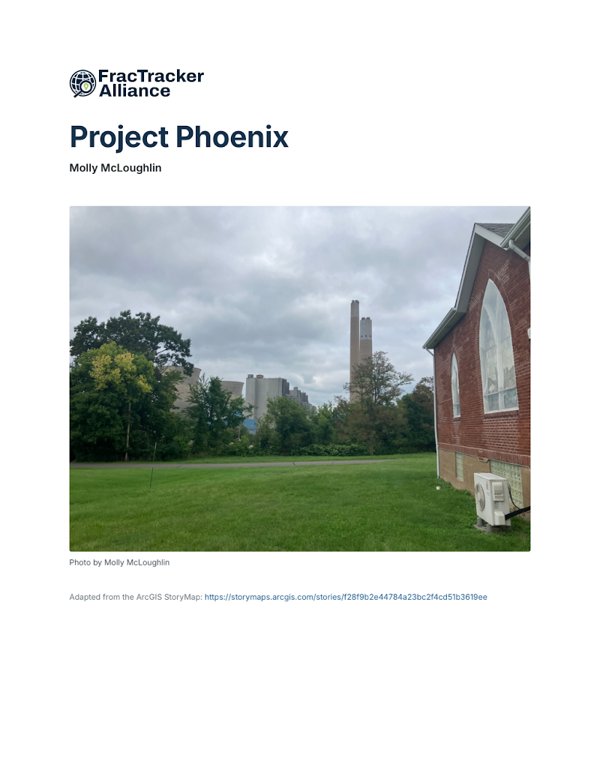
Project PhoenixUnder construction · 2 GW, behind-the-meter powerResearch by Molly McLoughlinSite packet (PDF) · Story map in a new tab
Explore the Project Phoenix story map
Switch Pitt Race Data Center
Switch, a Nevada-based data center operator, announced plans in April 2026 for a three-building, 382-acre campus at the former Pittsburgh International Race Complex in Big Beaver Borough. The racetrack opened in 2002 as BeaveRun Motorsports Complex, and in 2011 Jim and Kathy Stout purchased the track, renaming and investing more than $15 million for it to grow into a regional motorsport hub. Two weeks before the racetrack's closure was announced in 2025, the borough amended its zoning ordinance to permit data centers under “Special Regulations.” The Borough formally advertised public hearing for September 16, 2025, to consider two ordinances together: Ordinance 245, amending the Zoning Ordinance and Zoning Map, and Ordinance 246, amending the Borough’s Local Economic Revitalization Tax Assistance (LERTA). The racetrack was purchased for $50 million in March of 2026 by Wampum I, LLC, a subsidiary of Switch.
The full Preliminary Land Development application for the Switch data center is available on Big Beaver’s website. Documents describing the plans Switch provided to Beaver County were obtained through a FracTracker submitted Right-to-Know request provided here. The plans describe three data center buildings, an electrical substation, a FirstEnergy switching station, and six permanent stormwater ponds discharging to unnamed tributaries of the Beaver River.
Timeline
- 2002Site opens as BeaveRun Motorsports Complex
- Sept 16, 2025Borough Council approves Ordinance 245
- Oct 1, 2025Track closure announced
- Dec 2025Save Pitt Race formalizes as nonprofit (3RMPS)
- March 4, 2026Land sold to Wampum I, LLC
- April 2026Switch publicly announces plans for the site
- June 2, 2026Switch holds press-barred, police-guarded town hall
- June 29, 20263RMPS holds counter town hall
- July 9, 2026Switch formally filed a development application
- Aug 27, 2026First public review of proposal at the Planning Commission Meeting

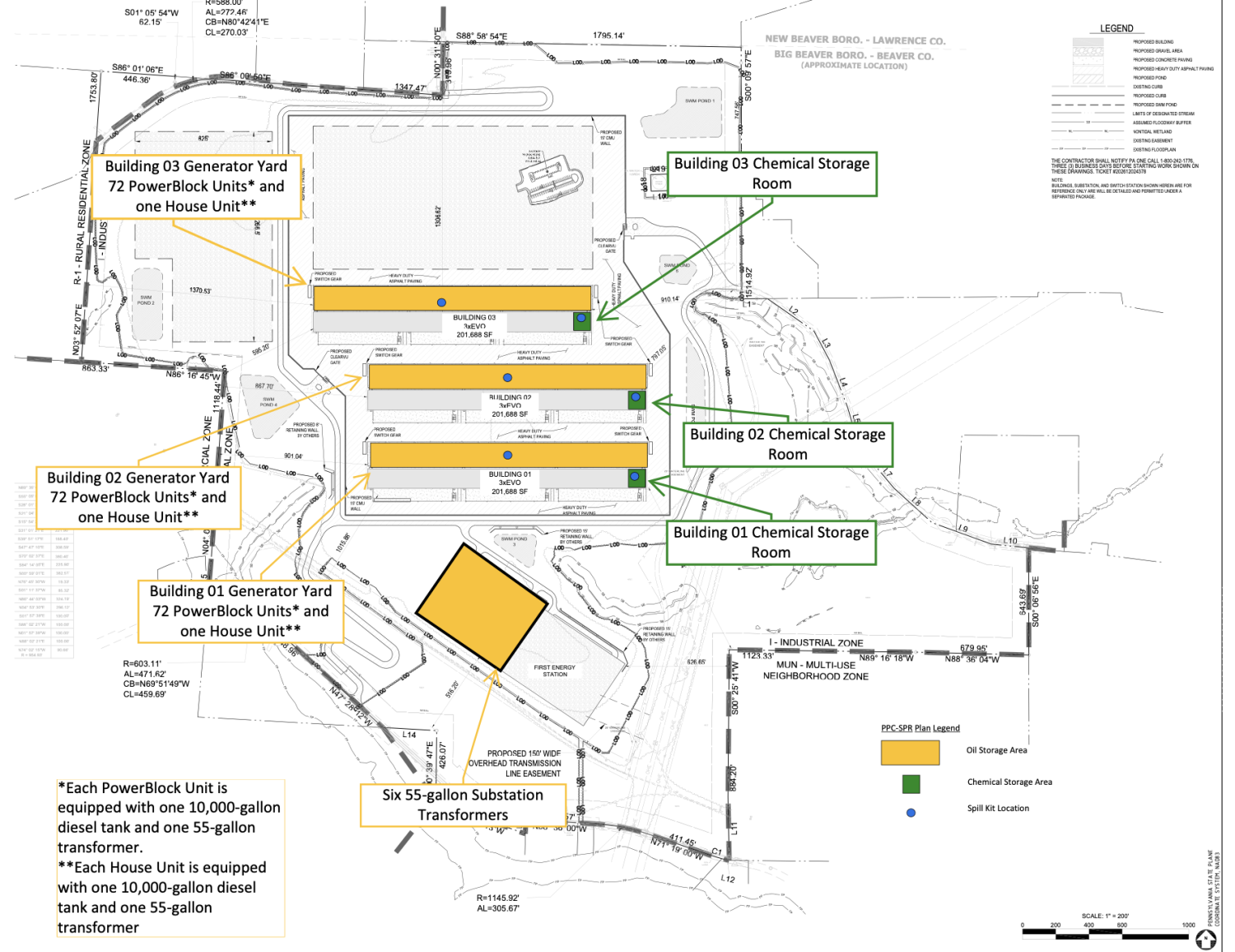
Data centers fall under Big Beaver Borough’s Ordinance 245’s Special Regulations category, which stipulates a 50-acre minimum tract, 100-foot setback, 75 dBA noise limit, and unrestricted 24/7 operation. Residents have argued that this framework is too permissive for a project of Switch’s scale and have pushed for a stricter Conditional Use classification instead. Switch’s application has proposed drawing water from the existing Beaver Falls Municipal Authority rather than on-site wells (said to be capped). Daily operational demand is projected at around 9,000 gallons per day across the buildings, covering typical daily use, fire service, and dust control during construction, as well as the initial fill and flush of the closed-loop cooling system. Switch states it will be coordinating with the Municipal Authority to avoid disruption. More specifically, involving stormwater, proposed detention and infiltration ponds are being designed to treat site runoff and preserve flow-path characteristics similar to those of existing conditions. On sewer capacity, the project proposes connecting to existing on-site sewer infrastructure, with each building expected to host no more than 120 occupants per day, for a maximum of 2,400 gallons per day, per building.

On roadways, the project proposes three access points: the existing Penndale Road entrance, the Eagle Rock Road driveway, and a new connection to Fairlane Blvd to handle increased traffic during construction. A full traffic study has yet to be completed. On earthwork and site stability, the preliminary plan set outlines three stages of the Erosion & Sediment Control plan. The preliminary geotechnical report states that there will be three stages of the Erosion & Sediment Control plan. The site itself contains undocumented, uncontrolled fill left over from the property’s prior use as a racetrack. Additionally, historic strip-mined areas from 1952 directly affect portions of the proposed development, including the northwestern cut slope, the western flat pad, and the western end of building 3, as well as the switching station and substation embankment slopes. Where mine spoils are located beneath buildings or sensitive infrastructure, the report indicates that ground improvement or deep foundations will be necessary, and embankments over spoils will require more robust draining.
The proposed site sits within a designated Environmental Justice Area under PennEnviroScreen, with a Final Score in the 94th percentile and a Pollution Burden score in the 97th percentile. Two standout indicators are traffic (95.5th percentile) and toxic air emissions (92.1st percentile), with hazardous waste and storage sites ranking in the 95.2nd percentile and mining concerns in the 89.3rd. Cancer sits at the 89.8th percentile, disability at 87.2nd percentile, and heart disease at 82.1st percentile.
Residents have raised concerns over noise, light pollution’s effect on wildlife, and water contamination. It has also been argued that the project does not fit with the area’s rural character. The proposal will affect a floodway, wetlands, and Stockman Run, which is listed in the Beaver County Natural Heritage Inventory. The company’s modeled highest level of noise falls under the Borough’s legal limit, between 44.8 and 55.6 dBA. Many are skeptical that the 80-100 permanent jobs projected at buildout or the 1,500 - 2,000 construction jobs over a two-year period will offset the loss of a venue that drew thousands on race weekends. Organized opposition has sustained. The advocacy group 3RMPS formed within weeks of the closure announcement, and a broader petition to repeal Ordinance 245 has drawn over 700 signatures.
Aliquippa Data Center Land Advertisement
Aliquippa Data Center Campus is a data center site proposed by Five 9s Digital. It is located at 71 Woodlawn Road, at the former J&L Steel brownfield site in Aliquippa, PA.

Plans describe behind-the-meter power with two 248 MW gas power plants on site, totaling 496 MW, which would supply the data center. The proposal site is 86 acres, with an additional 15 acres adjacent to it for a dedicated substation. Plans include one 250,000 sq ft data center building, expandable to a second floor that would increase the size to 500,000 sq ft. This data center would utilize water from the adjacent Ohio River for cooling.
Importantly, these plans are only outlined in a slide deck by Five 9s Digital, a national data center investment, consulting, brokerage, and development advisory firm. This deck claims approval from the Pennsylvania Public Utility Commission for the behind-the-meter power, but no record of this could be found. Overall, there seems to be little action taken to move these plans forward. The site itself is not owned by Five 9s Digital but rather Beaver County Corporation for Economic Development. The City of Aliquippa Council submitted and voted on a resolution to rezone the parcel to allow data center development, but the outcome is unknown. In the same slide deck, they proposed a second site in Aliquippa proximate to the one on Woodlawn Rd. However, even less has been done to show that this is in progress, as the land is still owned by Bet-Tech International (formerly LTV Steel).
Big Digital Energy Data Center
Big Digital Energy is an operating crypto mining data center run by Big Digital Energy, Inc. (formerly Mawson Infrastructure Group). It is located at 950 Railroad Ave in Midland, PA, at another brownfield site formerly owned by J&L Steel in Midland. This site is right across the Ohio River from the Shippingport Project Phoenix site. The data center has at least 120 MW of capacity, which may be expanded to 144 MW. An SEC 10-K form filed in April 2024 indicates that this data center utilizes grid power and air cooling. The parcel that the data center sits on is owned by Jewel Acquisition LLC, who also owns a parcel between the existing site and the river. Additionally, in the same slide deck describing the Aliquippa sites from Five 9s Digital, a potential data center site is also listed in Midland up the road from the Mawson Data Center on 234 acres. This potential site is on parcels owned by Jewel Acquisition LLC and Midland LP. It is unclear at this time whether/how the existing data center will expand geographically or whether the Five 9s Digital site proposal is in any way connected to the existing Big Digital Energy site.

Washington and Greene Counties
Washington County was carved from a western portion of Westmoreland County in the 1700s and is home to universities, three county parks, and fourteen school districts. It has an extractive history including coal and natural gas, and is the most fracked county in Pennsylvania. In 2004, Pennsylvania’s first Marcellus shale gas well was drilled in Washington County. As of 2026, more than 2,200 fracked wells have been drilled in Washington County. The County population is around 210,000, with a median household income of nearly $79,000. Major pipelines, including Energy Transfer’s Revolution Pipeline, run through portions of the county, which makes it an attractive site for data center development. Washington County has four data center proposals and pre-proposals: Starpointe Industrial Park Data Center, Fort Cherry Development District, Champion Data Center Land Advertisement, and Zediker Station Data Center. Residents in Washington County have responded strongly to the data center buildout, with Hanover Township and South Strabane preemptively updating their ordinances to include data centers and heavy turnout at conditional use hearings.
Greene County is a rural community located in the southwestern corner of Pennsylvania, bordered by West Virginia to the south and the Monongahela River to the east. It is home to 33,885 people living across the county’s 578 square miles, with a median household income of over $68,000. It is an agricultural area with a university and a long-standing energy hub and technology center. Project Hummingbird is the only data center development in the County so far.
Table 4. Data Centers in Washington and Greene Counties, PA
| Name and address | Status | Stakeholders | Power |
|---|---|---|---|
| Project Hummingbird Alicia Road, Greensboro, PA 15338 | Proposed | Essential Utilities, International Electric Power of Pittsburgh (power provider) | Up to 910 MW, behind-the-meter gas |
| Starpointe Industrial Park Data Center Starpointe Blvd, Burgettstown, PA 15021 | Permits under review | Prime Data Centers LLC (developer) | 450 MW, behind-the-meter gas |
| Fort Cherry Development District Fort Cherry Road, McDonald, PA 15057 | Under construction | Imperial Land Corporation (developer), Liberty Energy (power provider), Range Resources (power provider) | Uncertain, behind-the-meter gas |
| Champion Data Center near Pittsburgh International Airport, Robinson Township, PA 15057 | Land advertisement | Next Generation Land Company (developer) | Uncertain |
| Zediker Station Data Center off Zediker Station Rd, South Strabane Township, PA 15301 | Land advertisement | CNX Resources (land owner), Jones Lang LaSalle (marketing and leasing) | 500-700 MW, behind-the-meter gas |
Project Hummingbird
Project Hummingbird is a proposed data center campus on the former Robena Mine brownfield site in Monongahela Township, Greene County, PA. International Electric Power (IEP) is leading the project, with plans for a total 910 MW build-out using on-site fracked gas power. Power sources include two Siemens H-class turbines that will power both the data center and the surrounding grid via the Ronco substation and the GMTJSA lines at Cabbage Flats, paired with a 1,820 MWh battery storage system for peak hours and backup generation. Developers cite a direct dedicated pipeline with up to 160,000 MMBtu/day capacity, sourced from Utica and Marcellus Shale under a firm 10+ year contract.
IEP has broken the development down into five phases:
- Reclamation grading and installation of domestic wet utilities (water and sewer to serve Sites 1 and 2)
- Construction of the water intake and treatment facilities, on-site power plant, and electric substation at Site 1
- Temporary internal power supply to the initial data center facilities on Site 2
- Construction of data center buildings on Site 2
- Ongoing reclamation activities west of Whitley Creek
No data center tenant has been explicitly identified, and only Phase 1 (site reclamation) of 5 has been approved by the Greene County Planning Commission as of December 2025. The behind-the-meter power plant and the data center itself are still up for review.

At the December 17, 2025, Planning Commission meeting, residents raised concerns about the risks associated with reclamation and data center operations. Because the site sits on former mine land, subsidence is high-risk, and the land remains in DEP's mine subsidence insurance program. The reclamation plan, in particular, calls for roughly 40,000 cubic yards of fill, partly within a floodplain, requiring formal FEMA review. IEP points to their three months of core sampling and planned pilings as a mitigation approach. Additionally, the project seeks to raise the site’s power island by an average of about 16 feet. There is also the question of who’s financially responsible for reclamation of the site. A 2021 DCED-commissioned redevelopment playbook (under Section 6.1.1) for the Robena site reference a state-held reclamation bond of $7 million is posted by CONSOL Energy to guarantee reclamation is completed, otherwise CONSOL remains liable. The bonds are only released once an approved post-mining land use application goes through, however it is unclear whether that figure still reflects the current situation five years later.
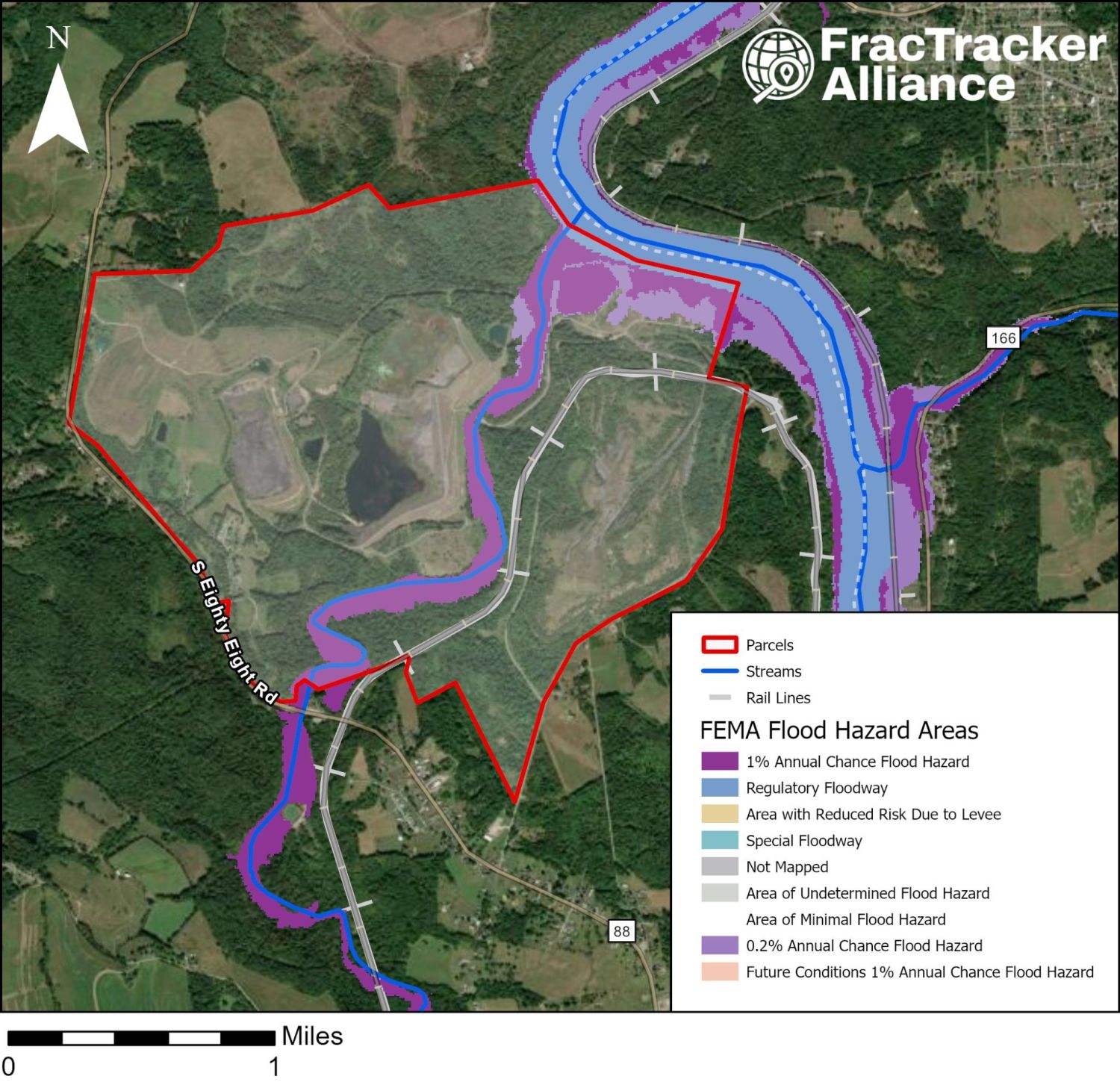
The site’s plan to use battery storage, in particular zinc-bromide Z3 batteries produced by EOS, also poses risks. At the same Planning Commission meeting in December, a resident testified during public comment that its safety data sheet flags it as toxic to aquatic life. Two documented off-gassing or spillage incidents were cited at that same meeting as having occurred at EOS’s own facility in the past two years, including a November 2025 incident at EOS’s Turtle Creek, PA facility. So far, IEP has only committed to future “diking and secondary containment,” without finalizing a plan.
For cooling, the proposal specifies an open-loop cooling system using water sourced from the Monongahela River. In IEP’s site packet, they advertise 18 million gallons per day of water capacity through a partnership with Essential Utilities/Aqua America. This estimate describes contracted capacity rather than daily use. In addition, residents have raised concerns about existing cancer-causing chemicals already in the river, and whether PFAS could be heated and vented to the atmosphere during cooling. A resident also cited that the local fire company has no ambulance service, and no funding, equipment, or training commitment has been made on record for a project at this scale. Residents also raised questions of Fayette EMS’s response times and level of care after an incident with a neighbor.
The Alicia community sits within a DEP-designated environmental justice area, in roughly the highest-risk 6% of communities nationally. This reflects a burden tied to the area’s history of coal mining and gas drilling. Community response and pushback have been organized primarily through the Center for Coalfield Justice (CCJ), which hosted a public meeting soon after the project’s announcement. Later, CCJ published a negotiations outline for residents, highlighting demands for local hiring, land buyout, and a share fund. Separate Community Benefit Agreements (CBAs) are in motion: one is being drafted by Township Supervisors in partnership with IEP, and another by Alicia residents.
Notably, Greene County has no county-wide zoning. It is important to recognize that though Hummingbird’s land use application states it does not intend to construct any single structure over 625 square feet, this can be misleading when taking into account proposed data centers and inconsistencies with the county’s SALDO. In looking at the full permitting chain, Township Supervisors stated the following review order: federal and state agencies, the county planning commission, the Greene County Conservation District, then the township’s engineer and solicitor will review road, stormwater, sewage, floodplain, and Universal Building Code compliance. Regarding zoning, Monongahela Township itself is not a zoned community, so it has no legal authority on the fronts of approval or disapproval for the location of proposed construction.
Fort Cherry Development District
The Fort Cherry proposal features a multi-tenant industrial park, flex logistics space, and high-density data center facilities. Imperial Land Corporation is the land developer while Liberty Energy Inc and Range Resources – Appalachia, LLC are partners in the onsite power generation agreement. Phase One of development was recently completed and includes three pad-ready development sites. The plant would start with modular 25 MW gas-fired blocks and could scale to 1 GW or more on the roughly 875-acre site. The power source will be fracked gas, and the data center will utilize a closed-loop water cooling system. The next development stages will include extension of critical roadways and traffic infrastructure and installation and connection of site utilities, including water, sewage, stormwater management, and gas lines.


Timeline
- March 2025Initial planning and infrastructure context advanced for the broader site in Robinson Township, Washington County.
- April 2025Liberty Energy Inc., Imperial Land Corporation, and Range Resources announced a partnership to build an on-site, modular gas-fired plant starting at 25 MW with the potential to scale up to 1 GW to support future data center tenants.
- October 2025The site has secured $7,700,400 through Pennsylvania's PA SITES program, consisting of a $5,175,000 grant and a $2,525,400 loan awarded to the Imperial Land Corporation for phases two and three of development.
- Spring 2026Ongoing development between the corporate partnership and prospective anchor data center tenants while infrastructure preparations progress.
Starpointe Industrial Park Data Center
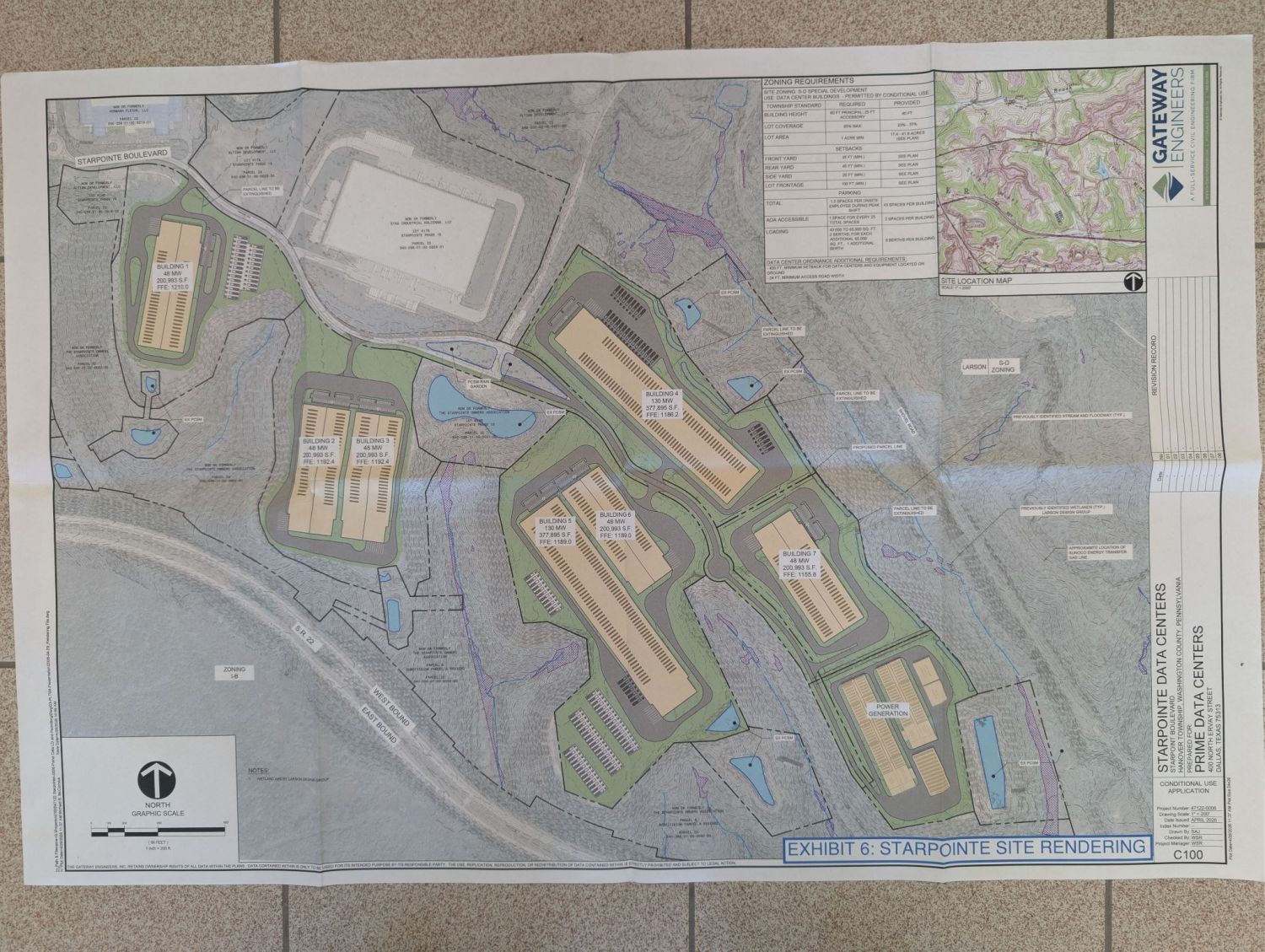
Starpointe Industrial Park is a data center development proposal site in Hanover Township, PA. The developer is Prime Data Centers LLC. The private land sale was negotiated between ALTIAN and Independence Excavating with little input or oversight from the Washington County Council on Economic Development. The hyperscale 450 MW proposal describes seven one-story buildings (1,500,000 sq ft) on 800 acres utilizing a closed-loop water cooling system.

Timeline
- Early Spring 2026Conditional use applications dated and submitted to the township.
- June 2026Prime Data Centers presented their plans at a Planning Commission Meeting. They discussed their conditional use applications for data centers and a power generation facility in Starpointe. The Township engineer provided a review letter and shared comments on the sound study and utility connections, and Prime indicated willingness to comply.
- August–September 2026Conditional use hearings (August 5, continued to August 31; further sessions September 21–30)
During Phase 1, the data center buildings would encompass more than 1.5 million square feet within the S-D and I-B zoning district. The site already has an NPDES permit for wastewater discharge. A separate conditional use application has been submitted for the behind-the-meter gas generation. The site will use fracked gas from the Energy Transfer-owned Revolution Pipeline via the Rover Pipeline.

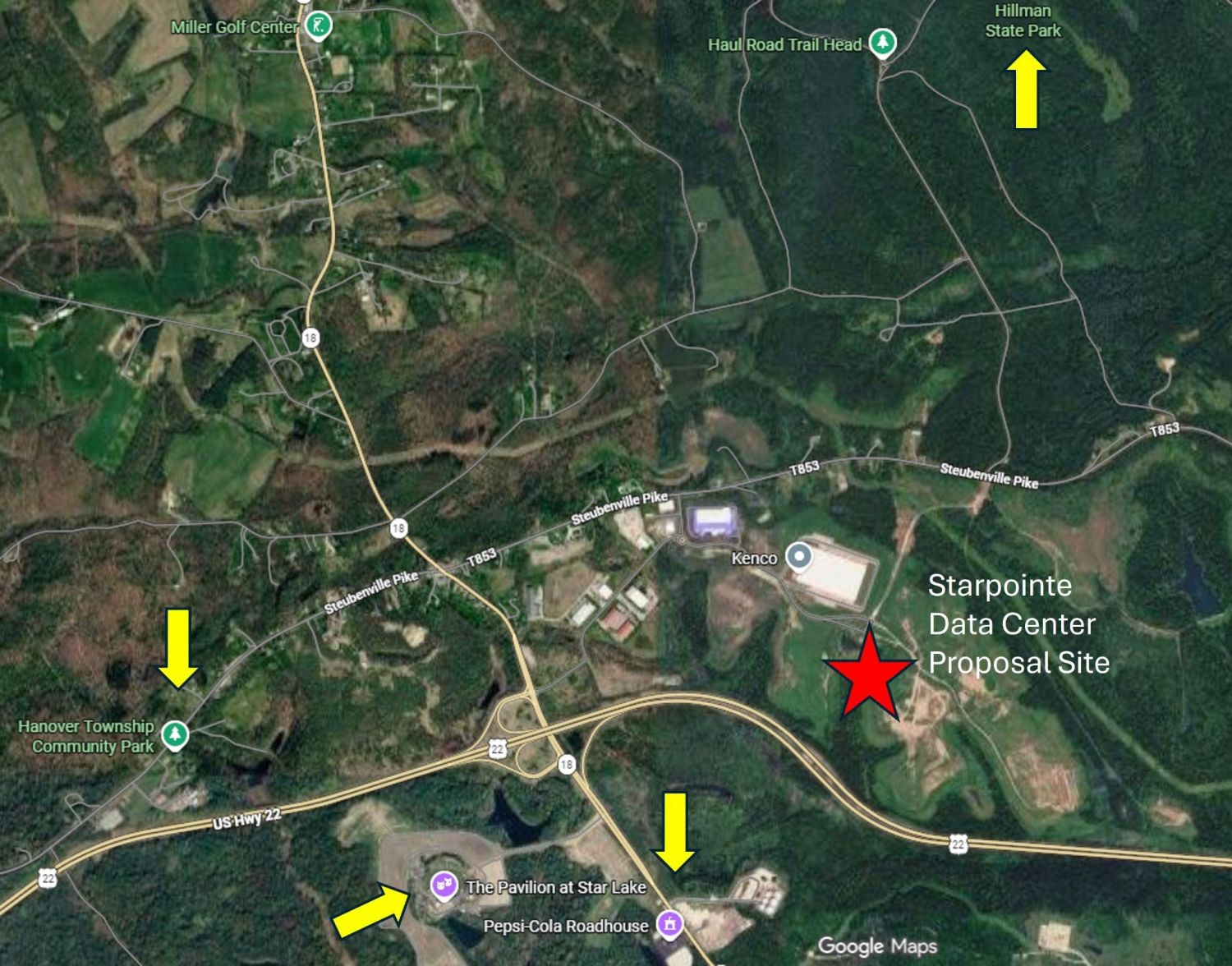
The data center is about 1 mile from The Pavilion at Star Lake and the Pepsi Cola Roadhouse, two popular music venues that many people visit. Hanover Community Park also falls within this 1-mile buffer, and Hillman State Park is about 2.5 miles away.
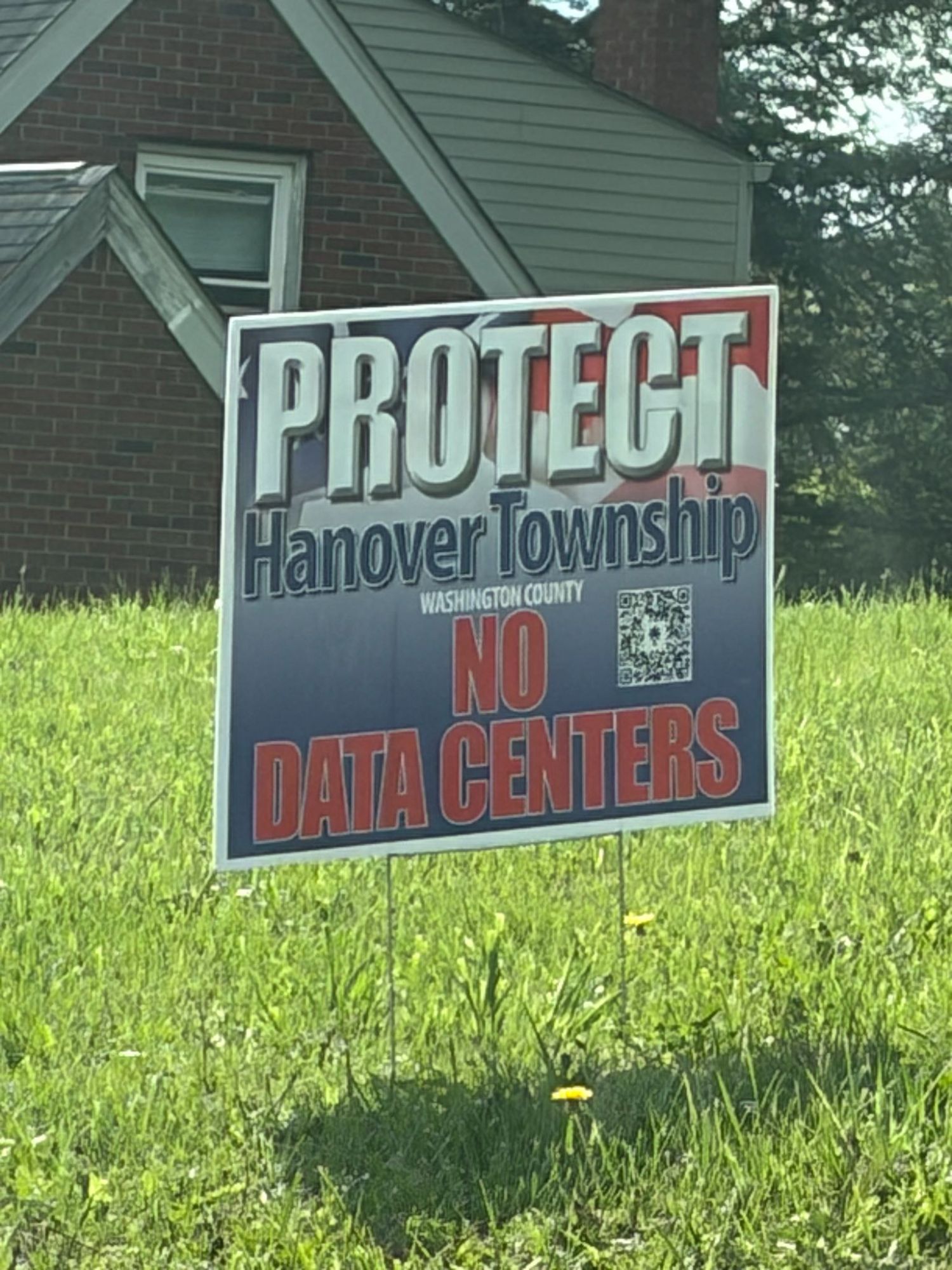
There has been strong community pushback against the data center development, as evident by the widespread use of yard signs and the high turnout at the conditional use hearing. The yard signs include Protect Burgettstown resources (including this petition). The ordinance in place for Hanover Township (enacted March 30, 2026) addresses noise pollution, vibration, light pollution, water usage, decommissioning, emergency plans, environmental monitoring, air quality, waste management, and community benefit agreement, though some question whether it is protective enough.
Zediker Station Data Center Land Advertisement
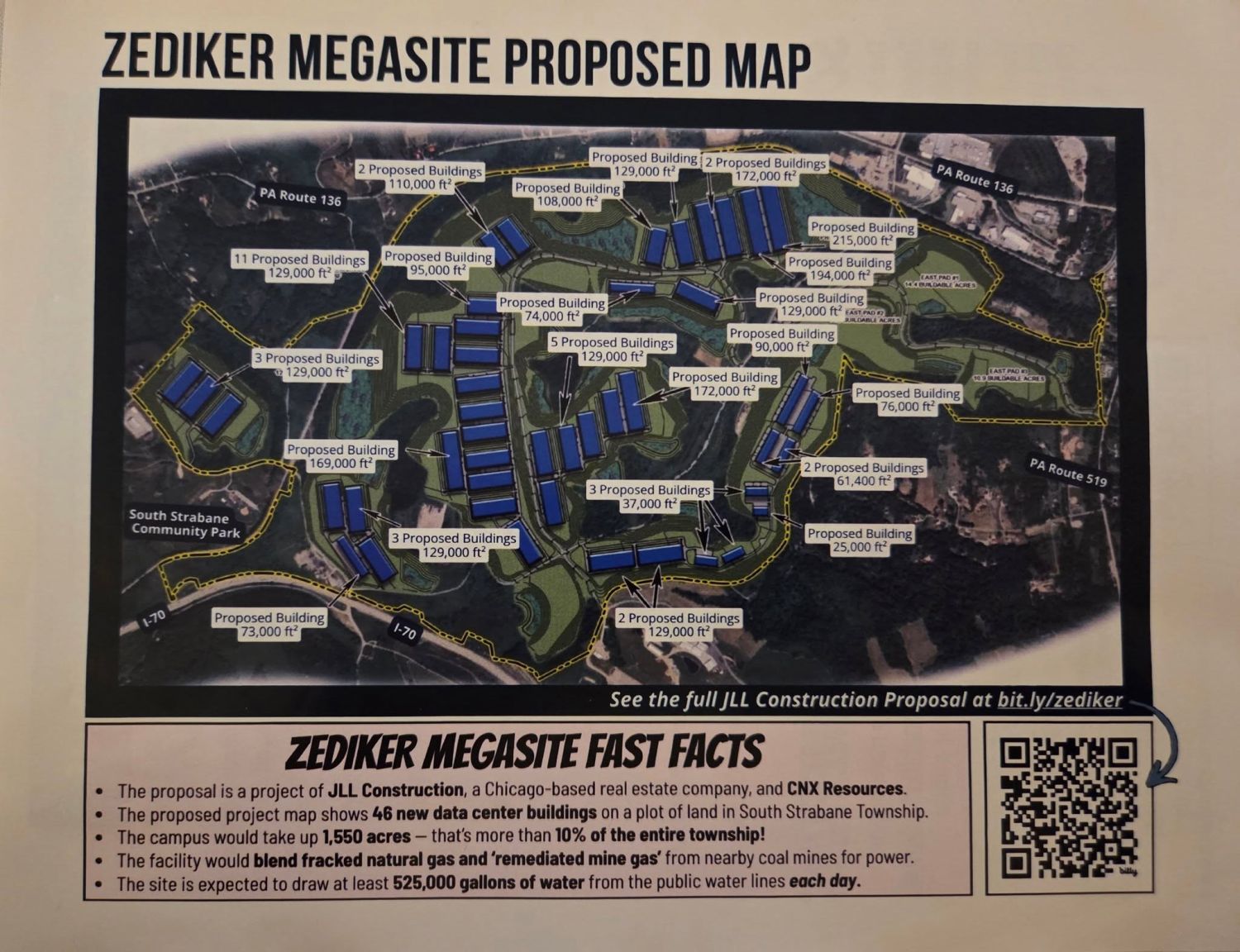
In the late 1800s in South Strabane Township, the Zediker family ran a farm on 1,200 acres of land in Washington County. In the 1900s, Robert Zediker donated a portion of the farm to the Baltimore & Ohio Railroad. The Meadow Land and Zediker Station opened on May 14, 1904, and ran between Meadow Lands and Manifold Mine (a 1.72-mile stretch of track crucial for the transportation of coal in Western Pennsylvania during that time period). CNX Resources currently owns the site, and they are interested in developing a hyperscale AI data center there with Jones Lang LaSalle (JLL).
Timeline
- October 20, 2025Real estate firm JLL and owner CNX Resources announce plans to market the 1,400-to-1,500-acre Zediker Station property in South Strabane Township as a carbon-neutral hyperscale data center site.
- December 2025South Strabane Township begins discussing preliminary draft zoning rules to regulate potential high-tech infrastructure.
- February 10, 2026South Strabane Township officially releases its draft data center zoning framework for public review.
- March 3, 2026The Allegheny Conference releases an economic impact analysis.
- March 19, 2026The Planning Commission recommended that supervisors approve the proposed data center and setback rules despite pushback from CNX representatives calling the restrictions exclusionary.
- June 9, 2026The South Strabane Township Board of Supervisors votes unanimously to adopt the data center ordinance. Under the ordinance, any data center proposal must include the latest water-conservation technology, including closed-loop systems to reduce demand on public water.
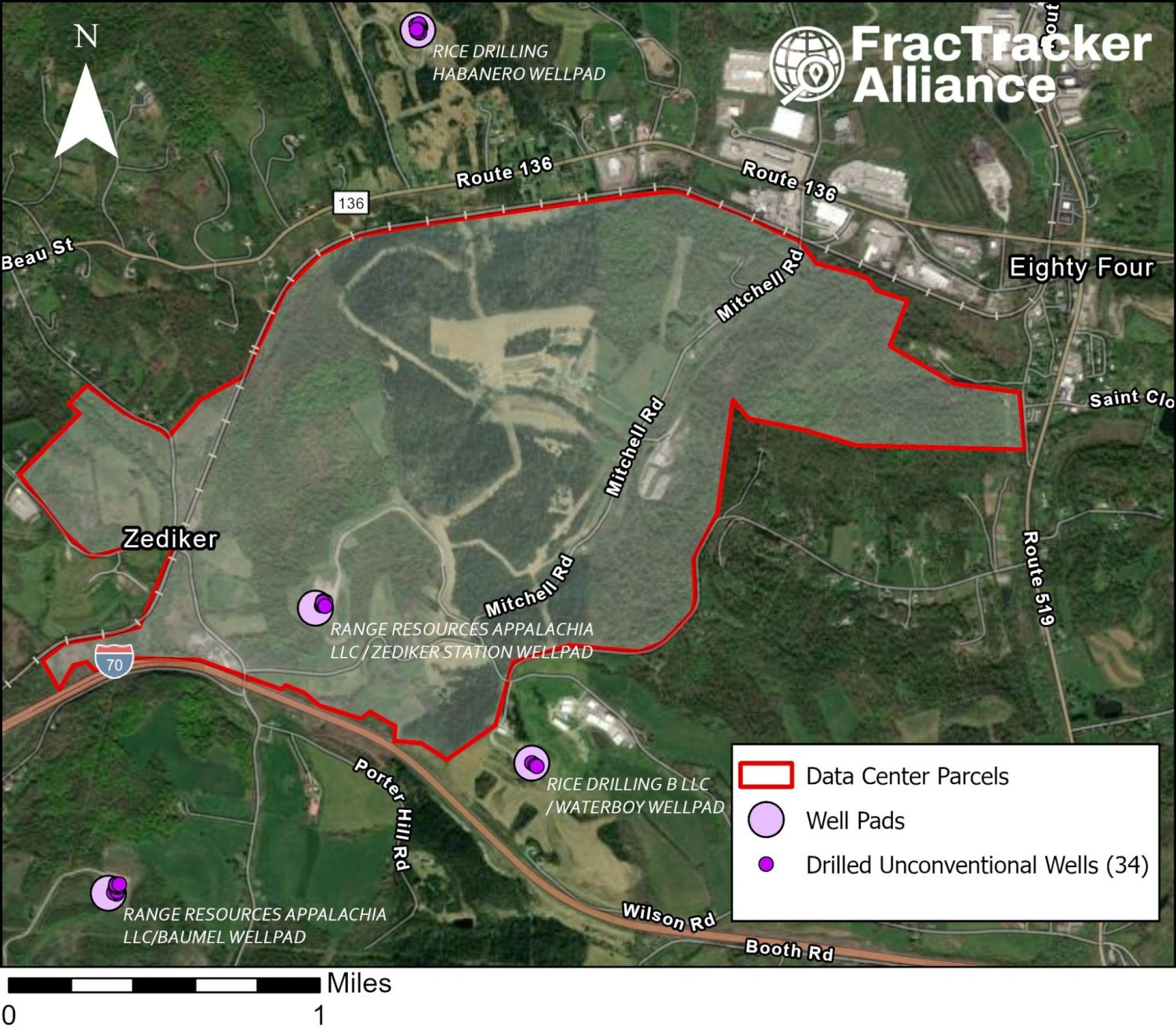
The site is proposed as “carbon-neutral” through the utilization of remediated mine gas. RMG is waste methane captured from coal mine ventilation systems. Township leaders are currently drafting a third ordinance governing fossil fuel power generation. The site has access to CSX and Norfolk Southern rail lines, is near FirstEnergy Corporation electrical infrastructure, and plans to access onsite and nearby fracked wells to supply 500-700 MW of power. The Allegheny Conference on Community Development conducted an economic impact analysis for the hypothetical data center on Zediker Station Road, promising economic output, jobs, and tax revenue. CNX Resources and JLL provided these figures.
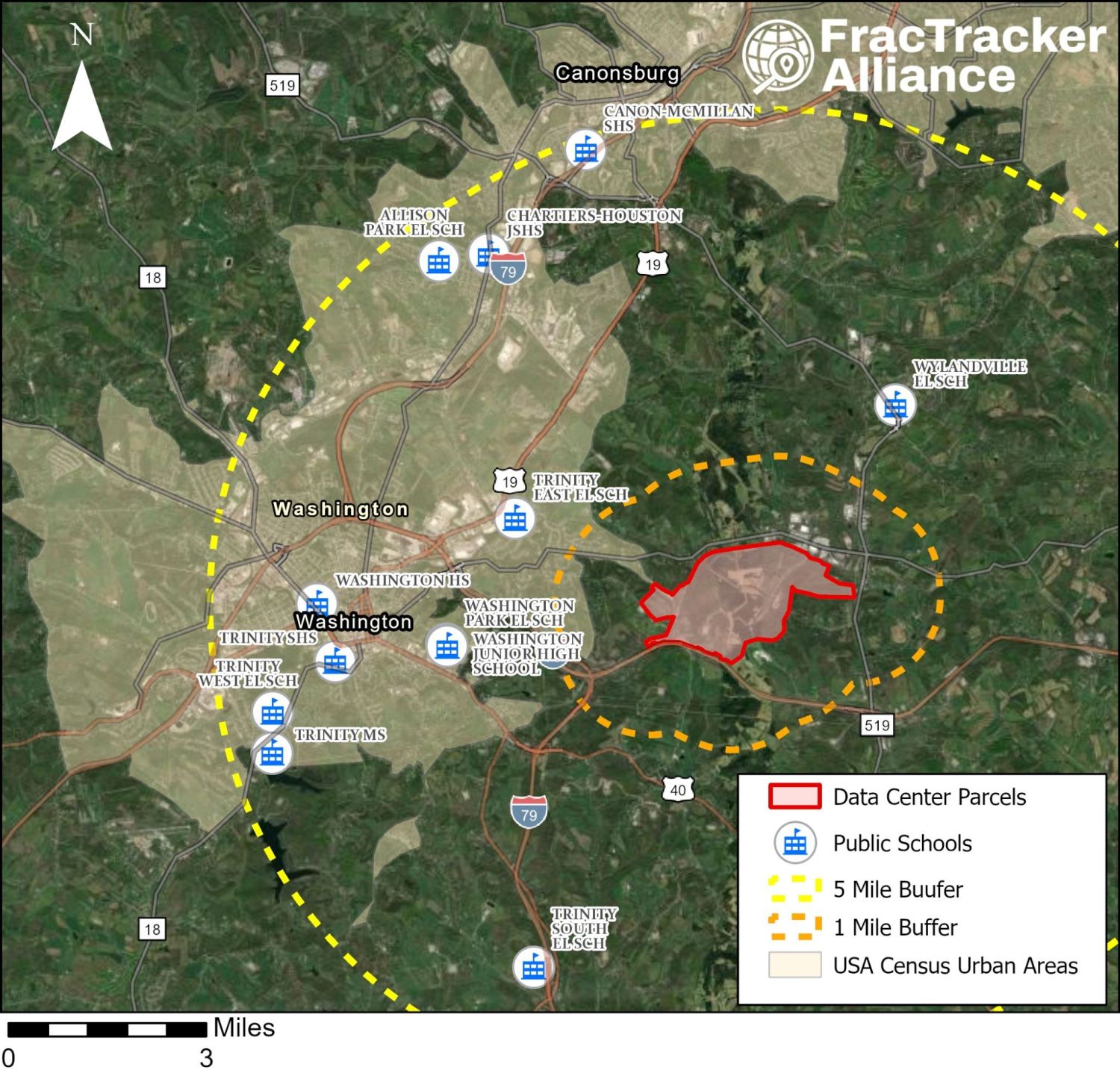
In an interview, a resident from the community stated: “First of all, we’re concerned, really, about changing the character of the community here. I’m concerned about electricity rates going up, water rates going up, noise, light…”. Additionally, Commissioner Electra Janis made a statement saying: “It’s really just not fair to the residents to put that [data center] in there. It does deserve development, but not that type of development”. A community petition is seeking 1,000 signatures from concerned citizens.
Champion Data Center Land Advertisement
In March 2026, Next Generation Land Company CEO Brian Patten posted on LinkedIn, advertising the Champion Data Center Campus: a 1,039 acre parcel of brownfield land in McDonald. Next Generation Land Company operates by purchasing potential data center sites, securing permits and power capability, and selling them to clients. Champion Processing, Inc. purchased the land in November 2020. Selling points include access to major gas pipelines (allegedly 2 on-site and 4 others within 3 miles) and 5 GW of natural gas generation capacity (upgradeable to 16 GW). Additionally, existing grid connections could allow up to 315 MW of power. The feasibility of these claims is not provided.

The site sits on the Beech Hollow slate pile, the largest collection of coal waste "East of the Mississippi". This may relate to the advertisement’s mention of “carbon-negative power” at $0.012 per kWh, which claims that on-site vacuum pyrolysis would turn coal waste into sustainable energy. Vacuum pyrolysis derives energy from agricultural waste. Additionally, the area is a potential Keystone Opportunity Zone, offering significant tax benefits for up to ten years. Notably, the site is seven miles away from the Fort Cherry Junior-Senior High School. The site and adjacent areas, such as parts of Smith Township, are designated Environmental Justice Areas under PennEnviroScreen. The census block group has a population of 1,147 and ranks in the 98.7th percentile for pollution burden and the 73.5th percentile for asthma diagnoses.
Discussion
Development Trends
Across the twelve proposals we tracked in Allegheny, Beaver, Greene, Indiana, Washington, and Westmoreland counties, several patterns emerged. We noticed that many of the developments took advantage of spaces left over by former industries, spaces associated with many years of pollution, community harm, and environmental impacts. It was also difficult to find details about the specifics of the developments, especially descriptions of how developments might provide benefits to the communities they mean to share. Finally, we saw a good deal of uncertainty. The extent to which Southwestern PA will be reshaped into a data center landscape still remains to be determined.
Legacy industrial sites
Nearly every proposal we researched is sited on an industrial brownfield. The Homer City Energy Campus occupies what was once Pennsylvania's largest coal plant, Project Phoenix is planned on the retired coal-fired Bruce Mansfield Power Plant, and the Springdale Dynamo Data Center is sited on the former coal-fired Cheswick Generating Plant. In Beaver County, both the Aliquippa land advertisement and the operating Big Digital Energy facility in Midland sit on former J&L Steel property. Project Hummingbird would be built on the former Robena Mine, and the Champion advertisement sits on the Beech Hollow (Champion) coal refuse pile.
Brownfield sites are typically close to transmission interconnections, substations, rail access, pipeline rights-of-way, and water access. At Homer City, the developer explicitly retained the retired coal plant's PJM grid interconnection rights. These sites also have industrial zoning in place, which is appealing since rezoning can be a hard-fought battle that can stop a project from moving forward. Additionally, these sites are difficult to remediate and return to productive use, making proposals difficult to turn away. However, redevelopment often does not erase pollution, but instead builds on top of it.
Siting in environmental justice communities
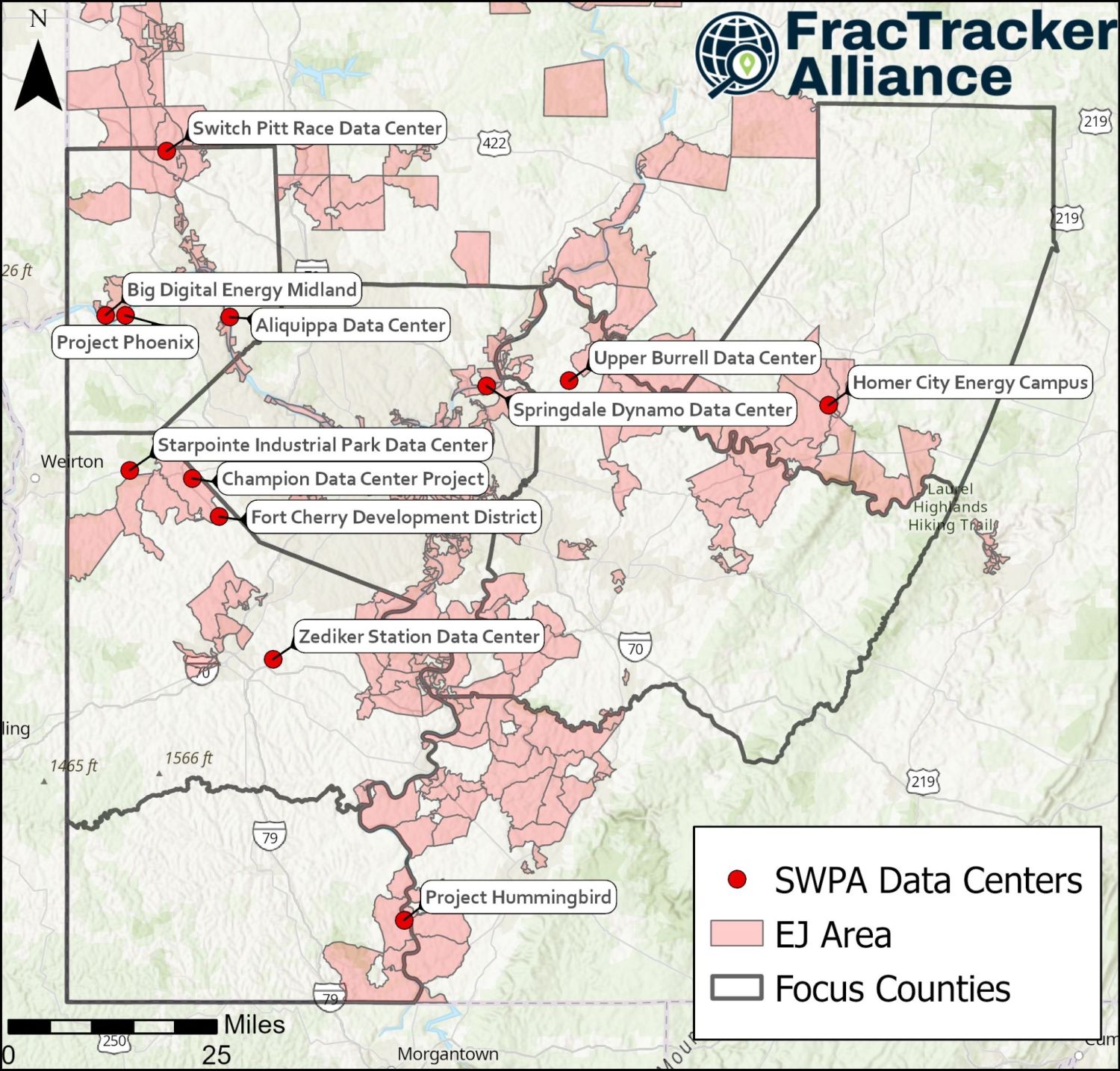
Sites shaped by the region’s extractive history are, unsurprisingly, located in vulnerable communities with disproportionate existing environmental exposure burdens and high rates of existing health problems. To identify such communities and ongoing legacies of environmental harm, the DEP designates certain places environmental justice areas. All of the data centers that we researched, except for Upper Burrell’s Keystone Connect, Project Phoenix, Starpointe Industrial Park Data Center, and the Zediker Station Data Center, are located in environmental justice communities.
Fracked gas buildout
The abundant fracked gas in southwestern PA has made it an attractive location for data center proposals. Nine of the twelve projects we researched feature behind-the-meter power generation. Homer City, Upper Burrell’s Keystone Connect, and Project Phoenix each plan 2 gigawatts (2,000 MW) or more of behind-the-meter generation. Project Hummingbird plans 910 MW, and Fort Cherry’s power partners say its plant could scale up to 1 GW. EQT, a major fracked gas company, is contracted to supply gas to Homer City and a gas plant Frontier planned at the Bruce Mansfield site, now Project Phoenix. Range Resources will supply gas to the Fort Cherry Development District, and CNX Resources owns the property at the Zediker Station site and would likely supply the remediated mine gas that the project advertises. Only Springdale’s Dynamo Data Center, Switch Pitt Race, and Big Digital Energy Midland plan to rely on the grid.
If all the proposals were built to their highest estimated capacities, more than 12.5 GW of new fracked gas-based electricity generation would be added to the region, not counting the three land advertisements at Aliquippa, Zediker Station, and Champion. To put this number in perspective, Pennsylvania used an average of about 16 GW in 2024, so this new generating capacity, if run continuously, would equal roughly three-quarters of the electricity used in the entire state. Such a buildout would mark a dramatic expansion of Pennsylvania’s fossil fuel industry, with impacts of a build out this size extending well beyond the property lines of the data centers. Additional fracked wells, gathering lines, compressor stations, and transmission will be needed to support the extraction, transport, and utilization of the gas.
Air quality concerns and cumulative pollution burden
The region stands to experience a notable decrease in air quality if these data centers and associated power generation become a reality. Air quality impacts are expected from data center back-up generators, onsite behind the meter generation, and indirect emissions from the increased fracking and power plant operation that will be needed to support grid connected facilities. These emissions can also have a considerable climate impact.
Burning gas emits toxins including nitrogen oxides (NOx), carbon monoxide, volatile organic compounds (VOCs), particulate matter (PM) 2.5, sulfur dioxide, and formaldehyde. These pollutants can increase asthma and respiratory problems, heart disease and stroke, and contribute to negative birth outcomes and cancer. Diesel backup generators are a particular concern as these units can emit 200-600 times more nitrogen oxides (NOx) than a natural gas power plant producing the same amount of energy. This effect is compounded when several data centers cluster in one area, like we are seeing in Beaver County and Washington County. The cumulative effects on air quality that are expected from this buildout merit evaluation and consideration, instead of the project-by-project assessment that is conducted for permits and other approval processes.
Unclear economic benefits
Developers often promise communities jobs and revenue in exchange for sharing their neighborhoods with loud industrial complexes. These benefits were one of the least documented parts of the proposals we reviewed. The most detailed economic analysis we saw was the Allegheny Conference on Community Development's study for Zediker Station, which projected $552 million in total economic output, 2,364 jobs, and millions in tax revenue. Where we could find data estimating job creation, we saw high numbers of construction jobs compared to a modest number of permanent positions. For example, Switch Pitt Race developers project around 100 permanent jobs compared to 2,000 construction jobs, and Homer City developers project 1,000 permanent jobs compared to 10,000 construction jobs. Due to the highly specialized nature of the work, many of these positions will be filled by traveling workers, not local residents. Homer City developers even plan to build temporary RV parks to house construction workers. Meanwhile, public money has already been dedicated to several projects, including Upper Burrell's Keystone Connect project and the Fort Cherry Development District.
Local control difficulties
Across the four projects we researched most closely, local control has been tested and has failed in several ways. In Springdale, the borough had no ordinance addressing data centers, so the developer could apply for project approval under a provision of the borough code covering uses "not specifically listed as permitted or conditional." The borough Council approved the conditional use permit over sustained public opposition because the Council members did not believe they could lawfully refuse. Upper Burrell enacted a 180-day curative amendment to update its local ordinances, but because the proposal had already been submitted, TECfusions’ Keystone Connect was grandfathered in. Shippingport had an ordinance addressing data centers, but Aligned requested eight variances from those limits and received seven. In Indiana County, the County's Subdivision and Land Development Ordinance (SALDO) is the only land-use tool available, and it is being amended to add data-center provisions while Amazon is in discussions with Homer City Energy Campus developers simultaneously and has submitted an application before the update is complete.
Lack of transparency
Information for many of the projects we researched was scant or difficult to obtain. The public learned of Amazon’s discussions with Homer City Redevelopment through a Right-to-Know request. At Project Phoenix, we were unable to find permits advertised by the State in the PA Bulletin and their former fast-track site. In a FracTracker submitted Right-to-Know request, it was revealed that Beaver County Commissioners told residents via email that they had no say in data center development because the county has no countywide zoning, while the same officials were receiving information directly from the developers of Project Phoenix and the Switch Pitt Race Data Center. For Starpointe, when we asked for the conditional use applications we were told that the only way to view them was to go to the Township building in person. Transparency failures are clear throughout the region, and residents are justifiably angry.
Executive Order 2026-05 – Protecting Pennsylvania Consumers from Data Center Impacts
On August 18, 2026, Governor Shapiro released Executive Order 2026-05: Protecting Pennsylvania Consumers from Data Center Impacts.
The order builds on the Governor’s Responsible Infrastructure Development (GRID) Standards, released May 27, 2026. GRID asks developers to meet standards in four areas:
- Energy affordability: Developers must show how electricity demand will be met without forcing costs onto ratepayers.
- Transparency and community engagement: Developers must provide adequate information on project scale, peak demand, outreach plans, public engagement, and disclosures.
- Workforce and economic development: Developers must make concrete commitments on jobs, workforce development, and community benefits.
- Environmental protection: Developers must address water usage, energy use and emissions, expected emission levels, and remediation measures tied to construction and operation.
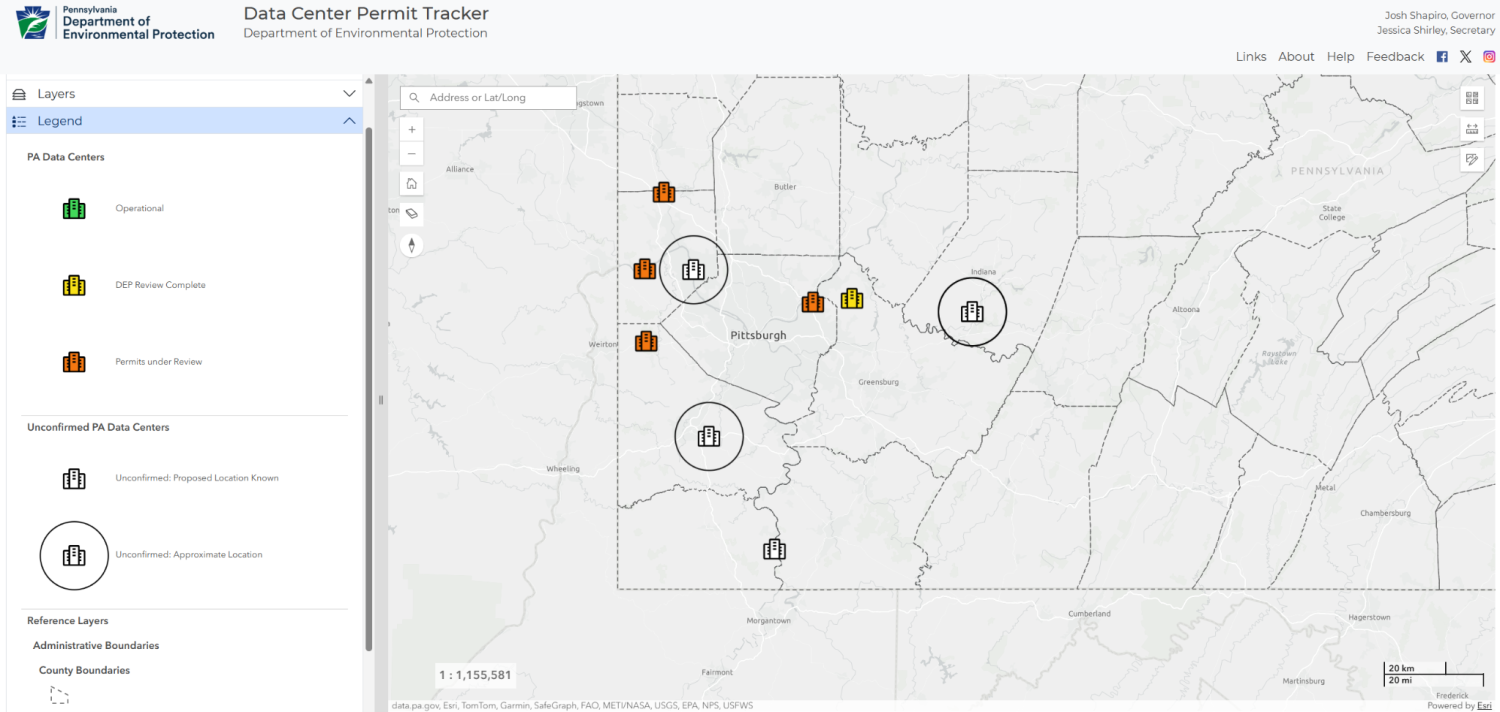
Requirements for local approval, reporting requirements for water and energy usage, the prohibition of NDAs, and the removal of projects from the PA Fast Track program are all positive steps to regulate the explosion of activity we’ve seen over the past year. The Data Center Permit Tracker released by the state is also a positive transparency step, which helps clarify which projects are actually in real conversations with the Commonwealth about development. However, the requirement of meeting the GRID standards introduced in May stipulates that “Developers must agree to build, bring online, or buy incremental electric capacity needed to meet new energy demand while paying the full cost of the capacity.” Nine out of the twelve data center proposals in our region are co-located with some form of behind-the-meter power, and further expansion of fracked gas will keep residents breathing polluted air and worsen the climate crisis. Furthermore, putting restrictions on data center developments does not address the more important question of whether or not these developments can exist in a responsible way that truly avoids impacts to Pennsylvanians. Therefore, the executive action stops short of the deeper reform that Pennsylvania needs.
Uncertainty
Importantly, many proposals may not come to fruition. A clear example is the McKees Rocks Data Center proposal. In 2023, SunCap Property Group purchased a 72-acre brownfield site on the former Pressed Steel Car Company plant near McKees Rocks. At the time, SunCap also applied for several forms of state aid, including PA SITES and Redevelopment Assistance Capital Program grants. These grants were obviously meant to be used to remediate the area for industrial use; specifically, $6,000,000 in PA SITES funding was awarded for “acquisition of land along the rail spur, soil screening and disposal, rail spur reconstruction, stormwater controls, utility relocation, sewer line replacement and remediation.” Although SunCap did not explicitly propose plans for a data center, it urged the Stowe Township zoning board to amend its zoning regulations to allow data centers in industrial sites. In December 2025, Stowe Township commissioners voted to approve the change, which would have allowed SunCap to build a data center in its industrial-zoned Pressed Steel Car Company plant. Given this information, many local newspapers such as PublicSource and WESA began reporting on a proposed data center in the area. In addition to official media coverage, Facebook posts rallying protest against the data center gained traction. On August 11, 2026, concerned residents attended a Stowe Township Board of Commissioners meeting, only to be told that news of a data center resulted from a miscommunication between the township and its people. Commissioners cited a lack of electronic infrastructure and written notices as the cause of the confusion. Regardless of earlier zoning changes, SunCap had not proposed building a data center on the property and was now considering a warehouse instead.
Conclusions
The story surrounding major regional data center developments in southwestern Pennsylvania exemplifies different important aspects of data center developments that we are seeing across the country, including behind-the-meter power buildout, the rallying of community voices and power, the use of moratoriums to buy time to update local ordinances, and lack of developer and local government transparency. Over the summer of 2026, our Data Center interns filed Right-to-Know requests, attended local government meetings, and searched for whatever documentation was available for the twelve data center projects and proposals in southwestern PA. Across projects, we saw similar patterns, including behind-the-meter power generation reliant on fracked gas, siting on brownfields in environmental justice areas, and a lack of transparency about crucial project details.
Homer City Energy Campus, Springdale Dynamo Data Center, Upper Burrell’s Keystone Connect Data Center, and Project Phoenix in Beaver County are projects that stood out as being well underway. Three of the other data centers are only land advertisements at this point, and details and final approvals for many sites are still pending. Local people are pushing back hard against these data centers with a ferocity rarely seen before. A few years ago, southwestern PA was slated to have a host of petrochemical ethane crackers constructed, and in the end only one was built. The data center buildout may play out the same way. Sharing our region with twelve or more data centers is not inevitable.
Take Action
- Support Senate Bill 1359 and demand a statewide data center moratorium
- Get involved with a local community group
Learn More
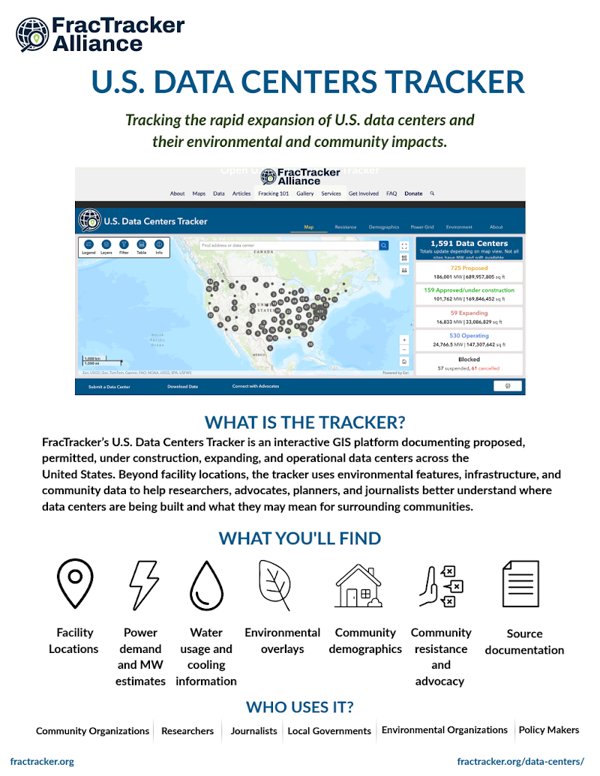
- Introducing the New FracTracker U.S. Data Centers Tracker Dashboard
- Tracking Data Centers: Energy Demand, Pollution, and Public Impact
- North Star Data Center Policy Toolkit
- FairShake PA Data Center Decision Tree and other resources
Fact Sheets and Site Packets
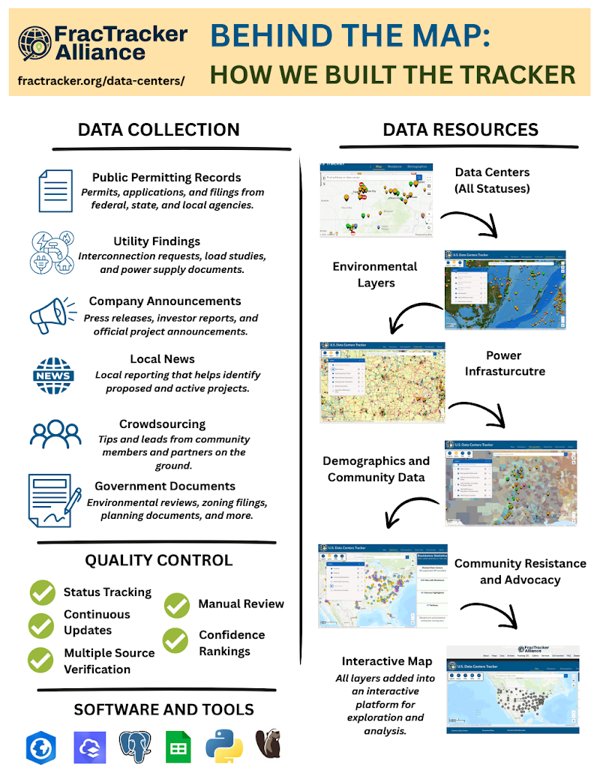
Notes
- According to the U.S. Energy Information Administration (EIA), the average U.S. home uses 10,500 kWh/year. Thus, 1 MW of continuous generation capacity is equivalent to approximately 834 homes powered. ↩
About this report: This report was researched and written during FracTracker Alliance’s summer 2026 Data Stewardship Sprint by Data Center Research Interns Leyu Belachew, Weronika Przedworska, Jenna Hoover, and Molly McLoughlin, with Data Center Fellow Mia Glover and Ohio River Valley Coordinator Katie Jones.
FracTracker Alliance helps communicate the risks of oil and gas and petrochemical development to advance just energy alternatives that protect public health, natural resources, and the climate.
By contributing to FracTracker, you are helping to make tangible changes, such as decreasing the number of oil and gas wells in the US, protecting the public from toxic and radioactive chemicals, and stopping petrochemical expansion into vulnerable communities.
Your donations help fund the sourcing and analysis of new data so that we can keep you informed and continually update our resources.
Please donate to FracTracker today as a way to advocate for clean water, clean air, and healthy communities.
Donate now
Leave a Reply
Want to join the discussion?Feel free to contribute!